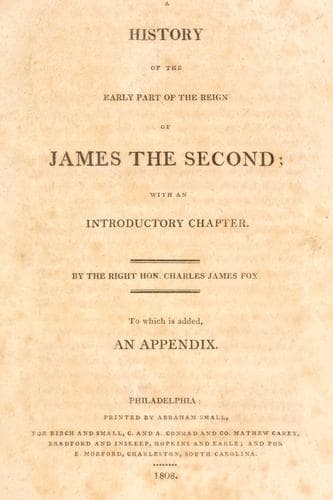
A History of the Early Part of the Reign of James the SecondFox, Charles James
History
A History of the Early Part of the Reign of James the Second
Fox, Charles James
Great Britain -- History -- James II, 1685-1688
The proceedings in Sidney's case were still more detestable. The
production of papers, containing speculative opinions upon government and
liberty, written long before, and perhaps never even intended to be
published, together with the use made of those papers, in considering
them as a substitute for the second witness to the overt act, exhibited
such a compound of wickedness and nonsense as is hardly to be paralleled
in the history of juridical tyranny. But the validity of pretences was
little attended to at that time, in the case of a person whom the court
had devoted to destruction, and upon evidence such as has been stated was
this great and excellent man condemned to die. Pardon was not to be
expected. Mr. Hume says, that such an interference on the part of the
king, though it might have been an act of heroic generosity, could not be
regarded as an indispensable duty. He might have said with more
propriety, that it was idle to expect that the government, after having
incurred so much guilt in order to obtain the sentence, should, by
remitting it, relinquish the object just when it was within its grasp.
The same historian considers the jury as highly blamable, and so do I;
but what was their guilt in comparison of that of the court who tried,
and of the government who prosecuted, in this infamous cause? Yet the
jury, being the only party that can with any colour be stated as acting
independently of the government, is the only one mentioned by him as
blamable. The prosecutor is wholly omitted in his censure, and so is the
court; this last, not from any tenderness for the judge (who, to do this
author justice, is no favourite with him), but lest the odious connection
between that branch of the judicature and the government should strike
the reader too forcibly; for Jeffreys, in this instance, ought to be
regarded as the mere tool and instrument (a fit one, no doubt), of the
prince who had appointed him for the purpose of this and similar
services. Lastly, the king is gravely introduced on the question of
pardon, as if he had had no prior concern in the cause, and were now to
decide upon the propriety of extending mercy to a criminal condemned by a
court of judicature; nor are we once reminded what that judicature was,
by whom appointed, by whom influenced, by whom called upon, to receive
that detestable evidence, the very recollection of which, even at this
distance of time, fires every honest heart with indignation. As well
might we palliate the murders of Tiberius, who seldom put to death his
victims without a previous decree of his senate. The moral of all this
seems to be, that whenever a prince can, by intimidation, corruption,
illegal evidence, or other such means, obtain a verdict against a subject
whom he dislikes, he may cause him to be executed without any breach of
indispensable duty; nay, that it is an act of heroic generosity if he
spares him. I never reflect on Mr. Hume's statement of this matter but
Public-domain text, read in full here on John Shaqi.
Reviews
Reviews
No reviews yet
Be the first to share your thoughts on this work.
Join the Discussion
Join the discussion
Sign in to leave a comment or review.
Sign InorCreate an account