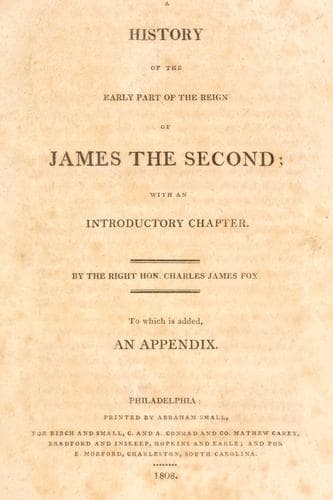
A History of the Early Part of the Reign of James the SecondFox, Charles James
History
A History of the Early Part of the Reign of James the Second
Fox, Charles James
Great Britain -- History -- James II, 1685-1688
After a few years of impatient submission to Lord North, Fox broke from
him, and it was not long before he had broken from Lord North's opinions
and taken the side of the people in all leading questions. He became the
friend of Burke; and joined in the attack upon the policy of Coercion
that destroyed the union between England and her American colonies. In
1774, at the age of twenty-five, Fox lost by death his father, his
mother, and his elder brother, who had succeeded to the title, and who
had left a little son to be his heir. In February of that year Lord
North had finally broken with Fox by causing a letter to be handed to him
in the House of Commons while he was sitting by his side on the Treasury
Bench.
"His Majesty has thought proper to order a new commission of the
Treasury to be made out, in which I do not perceive your name. NORTH."
By the end of the year he was member for Malmesbury, and one of the
chiefs in opposition. When Lord North opened the session of 1775 with a
speech arguing the need of coercion, Fox compared what ought to have been
done with what was done, and said that Lord Chatham, the King of Prussia,
nay, even Alexander the Great, never gained more in one campaign than
Lord North had lost. He had lost a whole continent. When Lord North's
ministry fell in 1782, Fox became a Secretary of State, resigning on the
death of Rockingham. In coalition with Lord North, Fox brought in an
India Bill, which was rejected by the Lords, and caused a resignation of
the Ministry. Pitt then came into office, and there was rivalry between
a Pitt and a Fox of the second generation, with some reversal in each son
of the political bias of his father.
In opposing the policy that caused the American Revolution Fox and Burke
were of one mind. He opposed the slave trade. After the outbreak of the
French Revolution he differed from Burke, and resolutely opposed Pitt's
policy of interference by armed force.
William Pitt died on the 23rd January, 1806. Charles James Fox became
again a Secretary of State, and had set on foot negotiations for a peace
with France before his own death, eight months later, at the age of fifty-
seven.
During the last ten or twelve years of his life Fox had withdrawn from
the dissipations of his earlier years. His interest in horse-racing
flagged after the death, in 1793, of his friend Lord Foley, a kindly,
honourable man, upon whose judgment in such matters Fox had greatly
relied. Lord Foley began his sporting life with a clear estate of 1,800
pounds a year, and 100,000 pounds in ready money. He ended his sporting
and his earthly life with an estate heavily encumbered and an empty
pocket.
H. M.
INTRODUCTORY CHAPTER.
Public-domain text, read in full here on John Shaqi.
Reviews
Reviews
No reviews yet
Be the first to share your thoughts on this work.
Join the Discussion
Join the discussion
Sign in to leave a comment or review.
Sign InorCreate an account