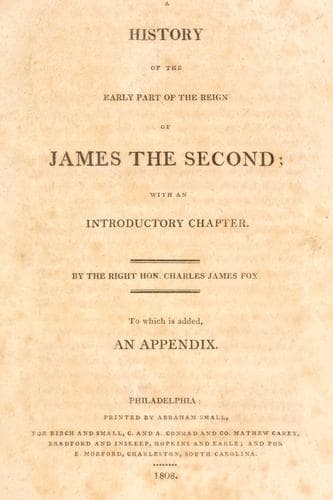
A History of the Early Part of the Reign of James the SecondFox, Charles James
History
A History of the Early Part of the Reign of James the Second
Fox, Charles James
Great Britain -- History -- James II, 1685-1688
Introductory observations--First period, from Henry VII. to the year
1588--Second period, from 1588 to 1640--Meeting of Parliament--Redress of
grievances--Strafford's attainder--The commencement of the Civil
War--Treaty from the Isle of Wight--The king's execution--Cromwell's
power; his character--Indifference of the nation respecting forms of
government--The Restoration--Ministry of Clarendon sod
Southampton--Cabal--Dutch War--De Witt--The Prince of Orange--The Popish
plot--The Habeas Corpus Act--The Exclusion Bill--Dissolution of Charles
the Second's last Parliament--His power; his tyranny in Scotland; in
England--Exorbitant fines--Executions--Forfeitures of charters--Despotism
established--Despondency of good men--Charles's death; his
character--Reflections upon the probable consequences of his reign and
death.
In reading the history of every country there are certain periods at
which the mind naturally pauses to meditate upon, and consider them, with
reference, not only to their immediate effects, but to their more remote
consequences. After the wars of Marius and Sylla, and the incorporation,
as it were, of all Italy with the city of Rome, we cannot but stop to
consider the consequences likely to result from these important events;
and in this instance we find them to be just such as might have been
expected.
The reign of our Henry VII. affords a field of more doubtful speculation.
Every one who takes a retrospective view of the wars of York and
Lancaster, and attends to the regulations effected by the policy of that
prince, must see they would necessarily lead to great and important
changes in the government; but what the tendency of such changes would
be, and much more, in what manner they would be produced, might be a
question of great difficulty. It is now the generally received opinion,
and I think a probable opinion, that to the provisions of that reign we
are to refer the origin, both of the unlimited power of the Tudors and of
the liberties wrested by our ancestors from the Stuarts; that tyranny was
their immediate, and liberty their remote, consequence; but he must have
great confidence in his own sagacity who can satisfy himself that,
unaided by the knowledge of subsequent events, he could, from a
consideration of the causes, have foreseen the succession of effects so
different.
Public-domain text, read in full here on John Shaqi.
Reviews
Reviews
No reviews yet
Be the first to share your thoughts on this work.
Join the Discussion
Join the discussion
Sign in to leave a comment or review.
Sign InorCreate an account