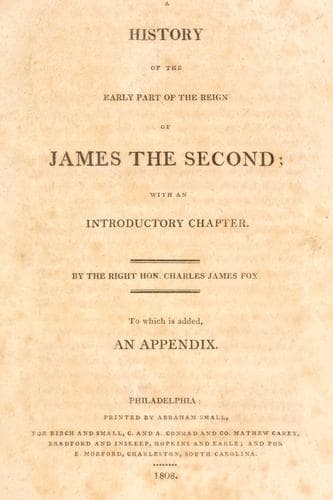
A History of the Early Part of the Reign of James the SecondFox, Charles James
History
A History of the Early Part of the Reign of James the Second
Fox, Charles James
Great Britain -- History -- James II, 1685-1688
Among the oppressions of this period, most of which were attended with
consequences so much more important to the several objects of
persecution, it may seem scarcely worth while to notice the expulsion of
John Locke from Christ Church College, Oxford. But besides the interest
which every incident in the life of a person so deservedly eminent
naturally excites, there appears to have been something in the
transaction itself characteristic of the spirit of the times, as well as
of the general nature of absolute power. Mr. Locke was known to have
been intimately connected with Lord Shaftesbury, and had very prudently
judged it advisable for him to prolong for some time his residence upon
the Continent, to which he had resorted originally on account of his
health. A suspicion, as it has been since proved unfounded, that he was
the author of a pamphlet which gave offence to the government, induced
the king to insist upon his removal from his studentship at Christ
Church. Sunderland writes, by the king's command, to Dr. Fell, bishop of
Oxford and dean of Christ Church. The reverend prelate answers that he
has long had an eye upon Mr. Locke's behaviour; but though frequent
attempts had been made (attempts of which the bishop expresses no
disapprobation), to draw him into imprudent conversation, by attacking,
in his company, the reputation, and insulting the memory of his late
patron and friend, and thus to make his gratitude and all the best
feelings of his heart instrumental to his ruin, these attempts all proved
unsuccessful. Hence the bishop infers, not the innocence of Mr. Locke,
but that he was a great master of concealment both as to words and looks;
for looks, it is to be supposed, would have furnished a pretext for his
expulsion, more decent than any which had yet been discovered. An
expedient is then suggested to drive Mr. Locke to a dilemma, by summoning
him to attend the college on the first of January ensuing. If he do not
appear, he shall be expelled for contumacy; if he come, matter of charge
may be found against him for what he shall have said at London or
elsewhere, where he will have been less upon his guard than at Oxford.
Some have ascribed Fell's hesitation, if it can be so called, in
executing the king's order, to his unwillingness to injure Locke, who was
his friend; others, with more reason, to the doubt of the legality of the
order. However this may have been, neither his scruple nor his
reluctance was regarded by a court who knew its own power. A peremptory
order was accordingly sent, and immediate obedience ensued. Thus, while
without the shadow of a crime, Mr. Locke lost a situation attended with
some emolument and great convenience, was the university deprived of, or
rather thus, from the base principles of servility, did she cast away the
man, the having produced whom is now her chiefest glory; and thus, to
those who are not determined to be blind, did the true nature of absolute
Public-domain text, read in full here on John Shaqi.
Reviews
Reviews
No reviews yet
Be the first to share your thoughts on this work.
Join the Discussion
Join the discussion
Sign in to leave a comment or review.
Sign InorCreate an account