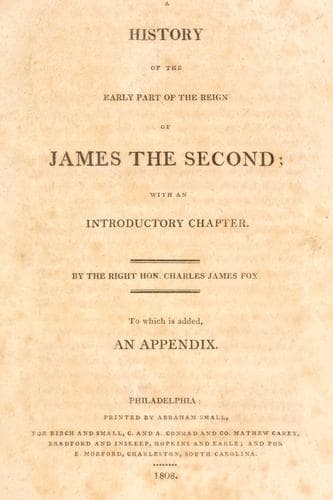
A History of the Early Part of the Reign of James the SecondFox, Charles James
History
A History of the Early Part of the Reign of James the Second
Fox, Charles James
Great Britain -- History -- James II, 1685-1688
power discover itself, against which the middling station is not more
secure than the most exalted. Tyranny, when glutted with the blood of
the great, and the plunder of the rich, will condescend to bent humbler
game, and make a peaceable and innocent fellow of a college the object of
its persecution. In this instance one would almost imagine there was
some instinctive sagacity in the government of that time, which pointed
out to them, even before he had made himself known to the world, the man
who was destined to be the most successful adversary of superstition and
tyranny.
The king, during the remainder of his reign, seems, with the exception of
Armstrong's execution, which must be added to the catalogue of his
murders, to have directed his attacks more against the civil rights,
properties, and liberties, than against the lives of his subjects.
Convictions against evidence, sentences against law, enormous fines,
cruel imprisonments, were the principal engines employed for the purpose
of breaking the spirit of individuals, and fitting their necks for the
yoke. But it was not thought fit to trust wholly to the effect which
such examples would produce upon the public. That the subjugation of the
people might be complete, and despotism be established upon the most
solid foundation, measures of a more general nature and effect were
adopted; and first, the charter of London, and then those of almost all
the other corporations in England, were either forfeited or forced to a
surrender. By this act of violence two important points were thought to
be gained; one, that in every regular assemblage of the people in any
part of the kingdom the crown would have a commanding influence; the
other, that in case the king should find himself compelled to break his
engagement to France, and to call a parliament, a great majority of
members would be returned by electors of his nomination, and subject to
his control. In the affair of the charter of London, it was seen, as in
the case of ship-money, how idle it is to look to the integrity of judges
for a barrier against royal encroachments, when the courts of justice are
not under the constant and vigilant control of parliament. And it is not
to be wondered at, that, after such a warning, and with no hope of seeing
a parliament assemble, even they who still retained their attachment to
the true constitution of their country, should rather give way to the
torrent than make a fruitless and dangerous resistance.
Public-domain text, read in full here on John Shaqi.
Reviews
Reviews
No reviews yet
Be the first to share your thoughts on this work.
Join the Discussion
Join the discussion
Sign in to leave a comment or review.
Sign InorCreate an account