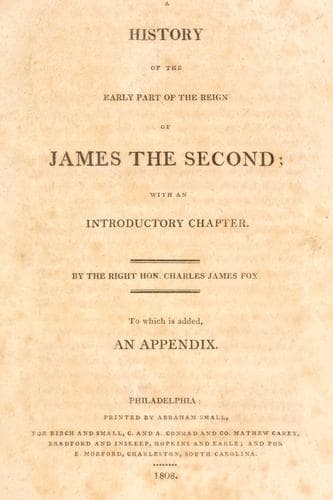
A History of the Early Part of the Reign of James the SecondFox, Charles James
History
A History of the Early Part of the Reign of James the Second
Fox, Charles James
Great Britain -- History -- James II, 1685-1688
considered as extorted from him; and a philosophical historian, writing
above a century after the time, can deem the pretended hard usage Charles
met with as a sufficient excuse for his breaking his faith in the first
instance, much more must that prince himself, with all his prejudices and
notions of his divine right, have thought it justifiable to retract
concessions, which to him, no doubt, appeared far more unreasonable than
the petition of right, and which, with much more colour, he might
consider as extorted. These considerations were probably the cause why
the Parliament so long delayed their determination of accepting the
king's offer as a basis for treaty; but, unfortunately, they had delayed
so long that when at last they adopted it they found themselves without
power to carry it into execution. The army having now ceased to be the
servants, had become the masters of the Parliament, and, being entirely
influenced by Cromwell, gave a commencement to what may, properly
speaking, be called a new reign. The subsequent measures, therefore, the
execution of the king, as well as others, are not to be considered as
acts of the Parliament, but of Cromwell; and great and respectable as are
the names of some who sat in the high court, they must be regarded, in
this instance, rather as ministers of that usurper than as acting from
themselves.
The execution of the king, though a far less violent measure than that of
Lord Strafford, is an event of so singular a nature that we cannot wonder
that it should have excited more sensation than any other in the annals
of England. This exemplary act of substantial justice, as it has been
called by some, of enormous wickedness by others, must be considered in
two points of view. First, was it not in itself just and necessary?
Secondly, was the example of it likely to be salutary or pernicious? In
regard to the first of these questions, Mr. Hume, not perhaps
intentionally, makes the best justification of it by saying that while
Charles lived the projected republic could never be secure. But to
justify taking away the life of an individual upon the principle of self-
defence, the danger must be not problematical and remote, but evident and
immediate. The danger in this instance was not of such a nature, and the
imprisonment or even banishment of Charles might have given to the
republic such a degree of security as any government ought to be content
with. It must be confessed, however, on the other aide, that if the
republican government had suffered the king to escape, it would have been
an act of justice and generosity wholly unexampled; and to have granted
him even his life would have been one among the more rare efforts of
virtue. The short interval between the deposal and death of princes is
become proverbial, and though there may be some few examples on the other
side as far as life is concerned, I doubt whether a single instance can
be found where liberty has been granted to a deposed monarch.
Public-domain text, read in full here on John Shaqi.
Reviews
Reviews
No reviews yet
Be the first to share your thoughts on this work.
Join the Discussion
Join the discussion
Sign in to leave a comment or review.
Sign InorCreate an account