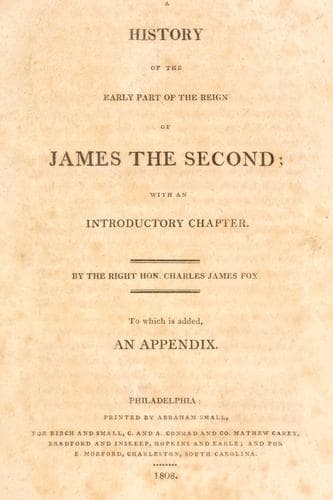
A History of the Early Part of the Reign of James the SecondFox, Charles James
History
A History of the Early Part of the Reign of James the Second
Fox, Charles James
Great Britain -- History -- James II, 1685-1688
The prosecution of Lord Strafford, or rather, the manner in which it was
carried on, is less justifiable. He was, doubtless, a great delinquent,
and well deserved the severest punishment; but nothing short of a clearly
proved case of self-defence can justify, or even excuse, a departure from
the sacred rules of criminal justice. For it can rarely indeed happen
that the mischief to be apprehended from suffering any criminal, however
guilty, to escape, can be equal to that resulting from the violation of
those rules to which the innocent owe the security of all that is dear to
them. If such cases have existed they must have been in instances where
trial has been wholly out of the question, as in that of Caesar and other
tyrants; but when a man is once in a situation to be tried, and his
person in the power of his accusers and his judges, he can no longer be
formidable in that degree which alone can justify (if anything can) the
violation of the substantial rules of criminal proceedings.
At the breaking out of the Civil War, so intemperately denominated a
rebellion by Lord Clarendon and other Tory writers, the material question
appears to me to be, whether or not sufficient attempts were made by the
Parliament and their leaders to avoid bringing affairs to such a
decision? That, according to the general principles of morality, they
had justice on their side cannot fairly be doubted; but did they
sufficiently attend to that great dictum of Tully in questions of civil
dissension, wherein he declares his preference of even an unfair peace to
the most just war? Did they sufficiently weigh the dangers that might
ensue even from victory; dangers, in such cases, little less formidable
to the cause of liberty than those which might follow a defeat? Did they
consider that it is not peculiar to the followers of Pompey, and the
civil wars of Rome, that the event to be looked for is, as the same Tully
describes it, in case of defeat--proscription; in that of
victory--servitude? Is the failure of the negotiation when the king was
in the Isle of Wight to be imputed to the suspicions justly entertained
of his sincerity, or to the ambition of the parliamentary leaders? If
the insincerity of the king was the real cause, ought not the mischief to
be apprehended from his insincerity rather to have been guarded against
by treaty than alleged as a pretence for breaking off the negotiation?
Sad, indeed, will be the condition of the world if we are never to make
peace with an adverse party whose sincerity we have reason to suspect.
Even just grounds for such suspicions will but too often occur, and when
such fail, the proneness of man to impute evil qualities, as well as evil
designs, to his enemies, will suggest false ones. In the present case
the suspicion of insincerity was, it is true, so just, as to amount to a
moral certainty. The example of the petition of right was a satisfactory
proof that the king made no point of adhering to concessions which he
Public-domain text, read in full here on John Shaqi.
Reviews
Reviews
No reviews yet
Be the first to share your thoughts on this work.
Join the Discussion
Join the discussion
Sign in to leave a comment or review.
Sign InorCreate an account