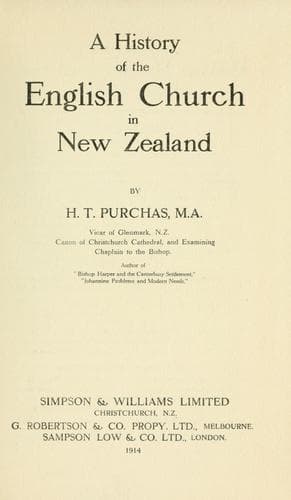
A History of the English Church in New ZealandPurchas, Henry Thomas
History
A History of the English Church in New Zealand
Purchas, Henry Thomas
Church of the Province of New Zealand -- History; New Zealand -- Church history
In the previous year, Bishop Williams had just concluded a half-century
of devoted and apostolic labour in New Zealand, when he was stricken
with paralysis, and shortly afterwards (May 31, 1876) resigned his see.
After a considerable interval, an Indian missionary, Edward Craig
Stuart, was elected to succeed him, and was consecrated at Napier in
December, 1877. The retiring bishop lived long enough to welcome his
successor, but was not able to join in his consecration.
In the following year, George Augustus Selwyn died at Lichfield. He had
never ceased to take an interest in New Zealand: in his palace chapel he
had put up a memorial window to the heroic Henare Taratoa; he had taken
the retired bishops Hobhouse and Abraham as his coadjutors; and, in the
hours of unconsciousness which preceded the last breath, he murmured two
sayings which seemed to go back to the old days of toil among the Maoris
and at St. John's College. One was, "They will come back." The other,
"Who's seeing to that work?"
CHAPTER XVII.
THE CHURCH OF TO-DAY.
(1878-1914).
Thus onward still we press,
Through evil and through good.
--_H. Bonar._
The earliest stage of church-life in colonial New Zealand may be called
the _Eucalyptus_ or Blue Gum period. These dark-foliaged trees mark from
afar the lonely sheep-station, and are often the only guide thereto. It
is in the station-house or in the adjoining woolshed that the service is
held. Seldom is it conducted by an ordained minister, for the number of
such is small, and each priest has a large territory to visit. His
arrival on horseback is not always known beforehand, but in the evening
the "squatter" assembles his family and dependants, the men of the
station, and perhaps a few neighbours. Everyone is glad of the
opportunity. The dining-room or woolshed is made to look as devotional
as possible. The old prayer books brought out from England are produced.
There may be no musical instrument available, but some well-known hymn
is raised by the lady of the house. The priest, in his long surplice,
preaches a practical sermon, for he understands his people and knows
their lives. The service revives old memories in the worshippers, and
carries them back in thought to ancient churches and devout
congregations in the land from which they come.
Public-domain text, read in full here on John Shaqi.
Reviews
Reviews
No reviews yet
Be the first to share your thoughts on this work.
Elsewhere in the archive
Join the Discussion
Join the discussion
Sign in to leave a comment or review.
Sign InorCreate an account