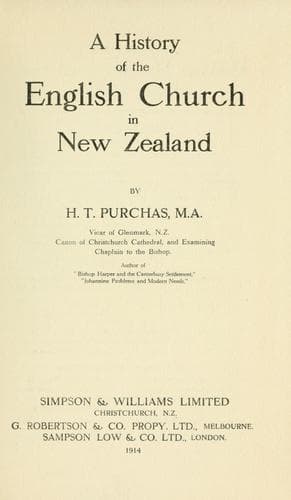
A History of the English Church in New ZealandPurchas, Henry Thomas
History
A History of the English Church in New Zealand
Purchas, Henry Thomas
Church of the Province of New Zealand -- History; New Zealand -- Church history
This early stage merges gradually into what may be called the Pine
period. The large sheep run is broken up into farms, each marked by its
sheltering plantations of _pinus insignis_. The typical place of
worship is now the school. To it the worshippers drive on Sunday, in
buggies or gigs. The services are carried on with some regularity:
different Christian denominations generally use the building on
successive Sundays of the month, and the same congregation gathers on
each occasion. The arrangements are awkward, the seats are comfortless,
but the singing is hearty and the feeling good. Memories of the old land
are less vivid: the young men and maidens are mostly native-born. There
is not the deep feeling of devotion, nor is there the old sense of the
overwhelming importance of divine things. Fewer of the labouring men are
present than were seen in the old woolshed services.
Years pass by, and a village springs up amidst the farms. Small
church-buildings rise almost side by side. The attendants of the
schoolroom no longer worship together. It is the Cypress or _Macrocarpa_
period, when trim hedges divide the gardens--and often the people--from
one another. But the little church, with its cross and other sacred
emblems, grows dear to some. The choir learns to chant and to sing an
anthem on a high festival. Perhaps now there is a vicarage beside the
church. Classes and guilds are carried on. "Church work" begins.
Such is the history of the Church in New Zealand during the latter
period of our hundred years. The frame of the picture is that supplied
by the originally treeless plains and valleys of the South Island. But
the picture itself, in its essential points, would represent other
regions as well--whether mining, maritime, or forest. As a picture, it
is not as bright as we should like it to be; but its shadows as well as
its brightness are but extensions of the phenomena of the religious
world outside. The divisions of Christendom did not originate in New
Zealand.
With a background furnished by the process just described--a process
constant in character, though moving faster or slower according to the
variety of local conditions--we may now fill in the foreground of the
scene with the few events of the last 34 years, which stand out above
the general level of parochial or diocesan life.
The decade of the 'eighties saw no change in the constitution of the
episcopal bench. From 1877 to 1890 the bishops remained the same. Bishop
Harper passed his 80th year, but continued actively at work; after him
in order of seniority came Bishops Suter of Nelson, Hadfield of
Wellington, Cowie of Auckland, Neville of Dunedin, Selwyn of Melanesia,
and Stuart of Waiapu. All worked harmoniously together, the leading
personality being perhaps the Bishop of Nelson.
Public-domain text, read in full here on John Shaqi.
Reviews
Reviews
No reviews yet
Be the first to share your thoughts on this work.
Elsewhere in the archive
Join the Discussion
Join the discussion
Sign in to leave a comment or review.
Sign InorCreate an account