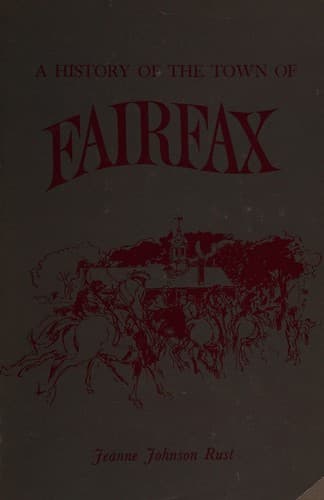
A History of the Town of FairfaxRust, Jeanne Johnson
History
A History of the Town of Fairfax
Rust, Jeanne Johnson
Fairfax (Va.) -- History
The inside of the court house was beautifully paneled with walnut
wainscoating and behind the Justice's chair the wall was paneled
from floor to ceiling. There was a gallery for slaves and rows of
hand carved wooden pews for freemen.
On the outside was a place for tying horses in the yard and nearby
stood a well with the traditional "old oaken bucket". The
inscription on the bucket read, "He who drinks therefrom will return
to drink again!"
Among the first Justices of the Peace to serve in the new Court
House after April of 1800 were James Coleman, David Stuart, Charles
Little, William Stanhope, Richard Bland Lee, Robert F. Hooe, William
Payne, Richard Ratcliffe, William Deneale, Humphrey Peake, Richard
W. Poeh, Hancock Lee, William Gunnell, Richard M. Scott, Francy
Adams, James Wiley, Augustine I. Smith, and James Waugh. These men
formed a committee that took turns serving as Justices of the Peace.
They were known as Gentlemen Justices and were appointed and
commissioned by the governor until 1851.
In 1843 an agricultural journal was published at the Fairfax County
seat. It was called the "Farmer's Intelligencer" and was edited and
published by J. D. Hitt. The first issue which appeared on October
21, 1843, showed agitation for a revision of the Virginia
constitution in advocating a more economical and simplified court
procedure. It may or may not have been indicative of general
feelings at the time, but from 1851 until 1870 Justices were elected
by the voters of the County. Among these were Silas Burke, John B.
Hunter, James Hunter, W. W. Ellzey, Minnan Burke, Ira Williams, M.
R. Selecman, William W. Ball, John Millan, Nelson Conrad, T. M.
Ford, David Fitzhugh, S. T. Stuart and Elcon Jones.
From 1870 to 1902 the County Court was presided over by a single
judge elected by the state's legislature. During that time Thomas E.
Carper, Richard Coleman, J. R. Taylor, J. F. Mayhugh and John D.
Cross were among those who served. Governor Yeardley's order was
abolished in 1902 by a constitutional convention and by 1904 the
circuit courts took over the former work of the county courts. Their
decline was brought about because they had become the symbol of
opposition to a centralized government. Thomas Jefferson said, "the
justices of the inferior courts are self-chosen, are for life, and
perpetuate their own body in succession forever, so that a faction
once possessing themselves of the bench of a county, can never be
broken up...."
John Marshall said "there is no part of America where less disquiet
and less ill feeling between man and man is to be found than in this
commonwealth, and I believe most firmly that this state of things is
mainly to be ascribed to the practical operation of our county
courts".
Public-domain text, read in full here on John Shaqi.
Reviews
Reviews
No reviews yet
Be the first to share your thoughts on this work.
Join the Discussion
Join the discussion
Sign in to leave a comment or review.
Sign InorCreate an account