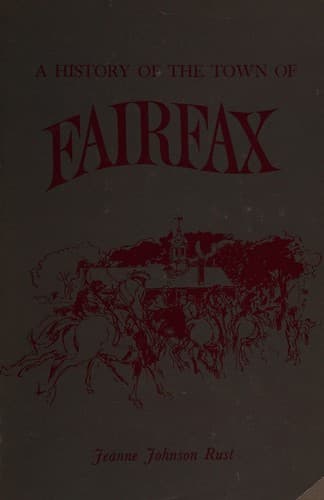
A History of the Town of FairfaxRust, Jeanne Johnson
History
A History of the Town of Fairfax
Rust, Jeanne Johnson
Fairfax (Va.) -- History
William Moss served as Clerk of the Court from 1801 to 1833. From
1833 until 1887 F. D. Richardson, Thomas Moss, Alfred Moss, S. M.
Ball, H. T. Brooks, W. B. Gooding, William M. Fitzhugh, D. F.
Dulaney, and F. W. Richardson served as Clerks. F. D. Richardson who
was born in 1800 and entered the Clerk's Office under William Moss
in 1826 was either Clerk, Deputy Clerk or Assistant Clerk to the
date of his death on October 13, 1880, a period of 50 years. His
son, F. W. Richardson, born Dec. 16, 1853, went into the Clerk's
Office when he was 18 years old (1871) and served as Deputy and
Assistant Clerk until the death of his father in 1880, when he was
elected Clerk of the County and Circuit Courts.
It is said that Ripley wrote in "_Believe It or Not_" that "'Uncle
Tude' (F. W. Richardson) and his father had been Clerks of the
Fairfax Courts continuously for one hundred and five years".
[Illustration]
VIII. DEVELOPMENT OF THE TOWN
As the court house drew men to this area and the population
increased, a school for girls was established on the property west
of Truro Episcopal Church. Known as Coomb's Cottage, it was a
finishing school for young girls and boasted a roster of
approximately one hundred young ladies from both the north and the
south.
The school was built and established by Dr. and Mrs. Baker, who were
English. In addition to the main house (a white frame building west
of the church), there were a number of other buildings. Two of these
are located across Route 236 from the Church and are still standing
today. One is a professional building, the other a private home.
They were moved to their present location by Judge Love when he
bought the original school property. (The school closed down during
the Civil War and was never re-opened).
The present Truro Episcopal Rectory had been built as a home by
Judge Love's father, Thomas R. Love, who later sold it to Dr.
William Gunnell and built his home in the large grove of trees on
the Layton Hall property, near the site of the present town hall.
"Dunleith", as the large brick home was called, was destroyed by
Union forces and replaced by an ordinary frame house after the war.
The Cooper Carriage house was built during this time by a Mr. Cooper
who had come to Fairfax from the North. Mr. Cooper was a highly
respected citizen and a very gallant Confederate soldier. He was
wounded seven times. Cooper Carriage House is located east of the
professional building which was a part of Coomb's Cottage.
Another house built before the Civil War was the home of Judge Henry
W. Thomas which stood on the site now occupied by the large,
pillared, grey stucco house belonging to Mrs. John Barbour. This
house served as headquarters for the Union officers and afterwards
as a hospital.
Public-domain text, read in full here on John Shaqi.
Reviews
Reviews
No reviews yet
Be the first to share your thoughts on this work.
Join the Discussion
Join the discussion
Sign in to leave a comment or review.
Sign InorCreate an account