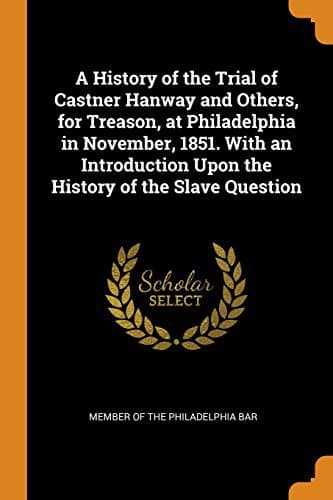
A History of the Trial of Castner Hanway and Others, for Treason, at Philadelphia in November, 1851: With an Introduction upon the History of the Slave QuestionMember of the Philadelphia bar
History
A History of the Trial of Castner Hanway and Others, for Treason, at Philadelphia in November, 1851: With an Introduction upon the History of the Slave Question
Member of the Philadelphia bar
Fugitive slaves -- Legal status, laws, etc. -- United States; Hanway, Castner, 1821-1893 -- Trials, litigation, etc.; Riots -- Pennsylvania -- Christiana; Trials (Treason) -- Pennsylvania -- Philadelphia; United States -- Fugitive slave law (1850)
intending, however, to make it the subject of a separate bill. The
chief reason assigned for this course was, the unwillingness of many
of the members to vote for a clause by which they might seem, however
indirectly, to sanction the idea that human beings were to be treated
like goods and chattels, and to be classed with and legislated upon as
such.
No member, however, was found disposed to moot the question so late in
the session, and it slept quietly till March of the following year,
when it presented itself in a new and much more troublesome form.
The interests of humanity involved in the abolition of slavery, had
not been left altogether to the mercy of politicians and political
expediency. At a much earlier period, philanthropic and religious
organizations had been established with a view to expedite a result
so consonant with the aims of humanity and justice. Among these, the
Society of Friends had especially distinguished itself, and some of
its more active members now resolved to seize the fortunate occasion,
offered by the establishment of a new and vigorous government, to
direct, if possible, some of its wholesome energies to the attainment
of their great object. The Yearly Meetings of Pennsylvania and
Delaware, accordingly united in a petition, praying Congress to
abolish the slave trade. The phraseology of the petition was a little
ambiguous, making it doubtful whether it really prayed an immediate
abolition, or only that Congress should use whatever power they might
possess under the Constitution, to discourage the hateful traffic.
Viewed in the latter light, the prayer was undoubtedly a most proper
one; and even if the former be its true construction, the petitioners
only shared an error common to some of the first statesmen of the
day--that of over estimating the powers of a newly constituted and
untried government. But whatever was its true meaning, the petition
broke like a thunderbolt over the heads of the irritable congressmen.
The debate exceeded in violence anything that had yet been heard.
The Quakers who had ventured to appear in the gallery to countenance
their unlucky petition, were encountered with scoffing and personal
abuse. Jackson renewed his former threats; the hall rang with cries
of dissolution; falling columns, torn flags, blood-stained battle
fields, and all the dread imagery that seems to be stereotyped in
some imperishable material, was paraded with frightful significancy
before the startled audience. On the following day, however, to which
the debate had been adjourned, the Friends appeared with a formidable
auxiliary indeed. Next to Washington, no man was regarded in those days
with more general veneration, than the sage and statesman, Franklin. As
early as 1787, this great and good man had been chosen first President
of a “Society for promoting the abolition of slavery, for the relief
of free negroes unlawfully held in bondage, and for improving the
Public-domain text, read in full here on John Shaqi.
Reviews
Reviews
No reviews yet
Be the first to share your thoughts on this work.
Join the Discussion
Join the discussion
Sign in to leave a comment or review.
Sign InorCreate an account