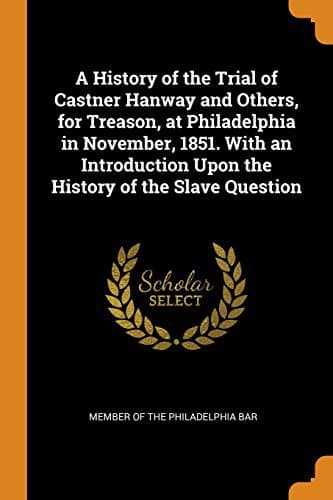
A History of the Trial of Castner Hanway and Others, for Treason, at Philadelphia in November, 1851: With an Introduction upon the History of the Slave Question — John Shaqi
A History of the Trial of Castner Hanway and Others, for Treason, at Philadelphia in November, 1851: With an Introduction upon the History of the Slave QuestionMember of the Philadelphia bar
History
A History of the Trial of Castner Hanway and Others, for Treason, at Philadelphia in November, 1851: With an Introduction upon the History of the Slave Question
Member of the Philadelphia bar
Fugitive slaves -- Legal status, laws, etc. -- United States; Hanway, Castner, 1821-1893 -- Trials, litigation, etc.; Riots -- Pennsylvania -- Christiana; Trials (Treason) -- Pennsylvania -- Philadelphia; United States -- Fugitive slave law (1850)
This famous debate, the parent of a countless offspring, resulted in
a compromise, recommended as “the most conciliatory, and the best
adapted to the present situation of things.” It consisted in carefully
striking out of the report every clause to which any body could frame a
serious objection, and entering the rest on the Journal without taking
any final action on it. The report as entered, asserted the power of
Congress to regulate the slave-trade, so far as to secure the humane
treatment of the slaves during their passage, to prohibit foreigners
from fitting out slave ships in our ports, and our citizens from
supplying foreign States with this commodity; but disclaiming all right
to interfere further before 1808, or to exercise any authority in the
emancipation of slaves already in bondage, or in the amelioration of
their condition. No intimation was made as to how they might choose
to exercise the powers thus claimed. The influence which this result
has had upon all after times, singularly confirms a prediction made
by Scott, in the course of the speech already referred to--“that what
was said, and more particularly what was done in Congress, at that
time, would in some degree form the political character of America on
the subject of slavery.” In fact, congressional legislation has never
departed from the standard here established. All attempts to make this
really a national question, have been uniformly employed for the mere
purposes of temporary agitation, and have as uniformly ended in a
compromise between a doubting majority and a resolute and unflinching
minority.
A question of much more practical importance at the present day, and
on which it would be extremely interesting to know the views expressed
by the sages who watched over the infancy of the Republic, must have
arisen in the House shortly afterwards. North Carolina had ceded
a portion of her enormous but unsettled territory to the General
Government, on the express condition, however, that Congress should do
nothing towards emancipating the slaves already to be found there. No
report, however, of the debate upon the bill has been preserved.
For some time after this, all agitation of the subject was carefully
avoided. Petitions were occasionally received from Abolition Societies
in New York and Pennsylvania, praying Congress to put to some practical
use the powers which, by the report entered on the Journal of the
House, they had declared themselves possessed of. Some were referred
to committees which never reported, others suffered to sleep quietly
on the table of the House, and one from Warner Mifflin, a well-known
Delaware Friend, escaped the obscurity in which its fellows were
forgotten, only to be returned to him with an abusive speech from North
Carolina, which nobody thought it worth while to answer.
Reviews
Reviews
No reviews yet
Be the first to share your thoughts on this work.
Join the Discussion
Join the discussion
Sign in to leave a comment or review.
Sign InorCreate an account