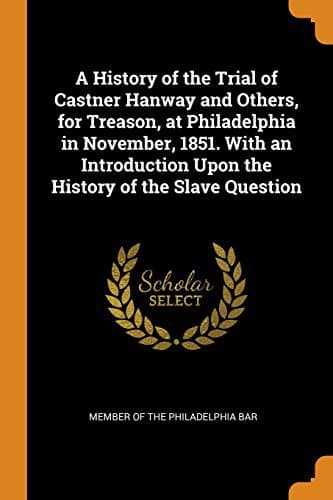
A History of the Trial of Castner Hanway and Others, for Treason, at Philadelphia in November, 1851: With an Introduction upon the History of the Slave QuestionMember of the Philadelphia bar
History
A History of the Trial of Castner Hanway and Others, for Treason, at Philadelphia in November, 1851: With an Introduction upon the History of the Slave Question
Member of the Philadelphia bar
Fugitive slaves -- Legal status, laws, etc. -- United States; Hanway, Castner, 1821-1893 -- Trials, litigation, etc.; Riots -- Pennsylvania -- Christiana; Trials (Treason) -- Pennsylvania -- Philadelphia; United States -- Fugitive slave law (1850)
The long wished for time at length arrived when Congress might
constitutionally abolish the slave trade, when the third compromise of
the Federal Convention was at length to expire, and the most glaring
contradiction in our history was to exist for the future only as a
recollection of the past, not as a present and pressing disgrace.
All parties were alike resolved to seize the happy occasion. Even
South Carolina for a while did not venture to disturb the general
unanimity, and resigned herself quietly to her fate. But as the
course of Congressional legislation never yet ran smoothly, so here
a singular notion was started in Committee by which it was proposed
to prohibit the traffic by heavy penalties, and yet at the same time
to enrich the National treasury by its proceeds. This extraordinary
plan proposed, in short, that all slaves captured in our vessels by
the United States cruisers, should be forfeited and sold by the United
States into perpetual slavery. Yet a plan so preposterous as this, by
which the National Government was to be deeply implicated in a crime
which it was the very object of the law to prevent, was triumphantly
carried by the violence of the southern members through every stage
of legislation to the very verge of final passage. Happily for the
honor of the country the North was at last aroused from her lethargy,
and by a desperate effort obtained a recommitment of the bill even at
this latest possible moment; the obnoxious clause was altered into a
binding out to service for a term of years in the free States, and
the bill came up for final action. What possible objection could be
taken to a provision which threw almost the whole burthen on the free
States, it is hard indeed to discover; but the idea of emancipating an
African, no matter under what circumstances, was altogether too much
for the equanimity of southern blood. Their members, as Ellsworth would
have expressed it, “immediately flew off into a variety of shapes,”
protesting that they would sacrifice their lives rather than submit to
it, and that military force should in vain attempt to force it on them.
This meaningless declamation was persisted in on the following day upon
some minor parts of the Bill providing for the transportation of slaves
by coasting vessels, requiring _manifests_ certified by proper officers
in order to prevent the obvious danger of deception being practised in
this way upon the general Government. The most audacious threats were
freely uttered. Randolph, the eccentric member from Virginia, took the
lead, gave his singular genius for virulent abuse full scope, and at
last concluded by hoping that if the Bill were signed by the President
in its present form, not a single southern member would be seen on the
floor of the next Congress. The bill was nevertheless signed as it
passed, the southern members came back punctually at the opening of the
next session, and have with praiseworthy regularity been drawing their
Public-domain text, read in full here on John Shaqi.
Reviews
Reviews
No reviews yet
Be the first to share your thoughts on this work.
Join the Discussion
Join the discussion
Sign in to leave a comment or review.
Sign InorCreate an account