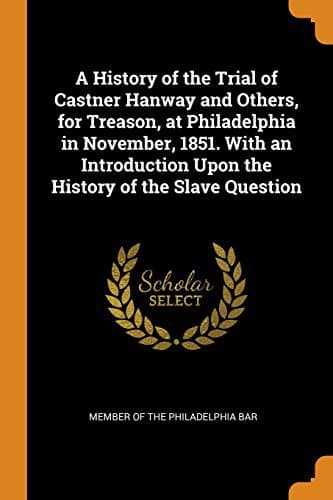
A History of the Trial of Castner Hanway and Others, for Treason, at Philadelphia in November, 1851: With an Introduction upon the History of the Slave Question — John Shaqi
A History of the Trial of Castner Hanway and Others, for Treason, at Philadelphia in November, 1851: With an Introduction upon the History of the Slave QuestionMember of the Philadelphia bar
History
A History of the Trial of Castner Hanway and Others, for Treason, at Philadelphia in November, 1851: With an Introduction upon the History of the Slave Question
Member of the Philadelphia bar
Fugitive slaves -- Legal status, laws, etc. -- United States; Hanway, Castner, 1821-1893 -- Trials, litigation, etc.; Riots -- Pennsylvania -- Christiana; Trials (Treason) -- Pennsylvania -- Philadelphia; United States -- Fugitive slave law (1850)
eight dollars per day from the National Treasury from that time to this.
With the passage of this great measure the victories of the
abolitionists reached their climax. From 1807 up to 1818 their
successes were fairly balanced by their reverses. The great
acquisitions of new territory during this period were so many triumphs
for the South, and the new free States which came into existence were
erected in districts into which the slave system had never ventured.
The spirit which had supported the friends of humanity in their
labors seemed to be gradually decaying. The representatives of free
principles in the southern States grew yearly less numerous, while an
unaccountable apathy was creeping over the once vigorous and energetic
societies of the North. Politicians took less and less interest in
views which, if openly professed, would rob them of many friends,
while candidates for National offices took refuge from such dangerous
ground in discreet silence or studied ambiguity. Without spending time,
therefore, upon the many less important debates that intervened between
this and the year 1819 we may pass at once to the memorable one which
in that and the following year, threw the whole nation into a state of
unparalleled excitement. A few remarks will serve to explain the origin
of this new form of the question. In 1787, before the adoption of the
Constitution, the old Congress had, by a _unanimous_ vote, passed
their famous ordinance for the government of the territories of the
United States. Among the fundamental conditions of this compact, as
it was called, and which was “forever to remain unalterable,” except
by the mutual consent of both the contracting parties, was an article
providing for the perpetual exclusion of slavery from this “virgin
soil.” The honor of introducing the provision has been since disputed
between Virginia and Massachusetts; but be that as it may, its adoption
seems to have been a natural effusion from the spirit of freedom
which warmed every heart in those days from New Hampshire to Georgia.
The subsequent cessions of territory by Georgia and North Carolina,
out of which the States of Mississippi and Tennessee were erected,
had, however, been guarded by express reservations of the rights of
slaveholders, and these reservations were, as we have seen, necessarily
respected by Congress. But upon the purchase of Louisiana and Missouri
from France in 1803, no such stipulations had been introduced into the
Treaty; yet while Congress does not seem to have thought itself at
liberty to interfere with the already vested rights of slaveholders
in those territories, every possible measure was adopted to prevent
the further increase of the race by migration or importation from
abroad. Louisiana was admitted almost immediately, passing with scarce
any transition from her condition as a French colony to that of an
independent American State. With regard to her, therefore, it was
Public-domain text, read in full here on John Shaqi.
Reviews
Reviews
No reviews yet
Be the first to share your thoughts on this work.
Join the Discussion
Join the discussion
Sign in to leave a comment or review.
Sign InorCreate an account