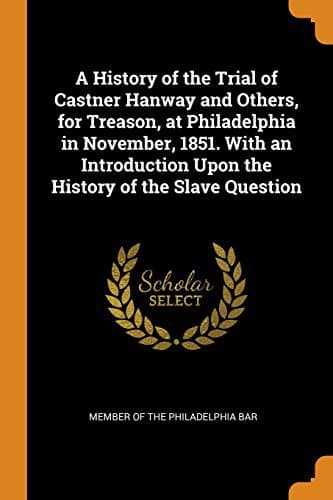
A History of the Trial of Castner Hanway and Others, for Treason, at Philadelphia in November, 1851: With an Introduction upon the History of the Slave QuestionMember of the Philadelphia bar
History
A History of the Trial of Castner Hanway and Others, for Treason, at Philadelphia in November, 1851: With an Introduction upon the History of the Slave Question
Member of the Philadelphia bar
Fugitive slaves -- Legal status, laws, etc. -- United States; Hanway, Castner, 1821-1893 -- Trials, litigation, etc.; Riots -- Pennsylvania -- Christiana; Trials (Treason) -- Pennsylvania -- Philadelphia; United States -- Fugitive slave law (1850)
thought inexpedient to startle these recently acquired and scarce
reconciled citizens, by legislation which they might misconstrue into
arbitrary misgovernment taking advantage of their helplessness. In
1802, 1816 and 1818, Ohio, Indiana and Illinois had been successively
and quietly admitted under the terms of the ordinance of ’87. The
country was thus in a state of perfect repose so far as this question
was concerned. All early excitement had died away, a new generation
had arisen in Congress, and new intellects were roaming about seeking
the material for agitation and display. At this juncture Missouri
applied for admission to the Union. A large majority of the Northern
members at once decided that they would in all future legislation bind
themselves irrevocably to the free principles of the ordinance of
’87. Missouri, it was true, had at the time a large number of slaves
within her borders, but upon these vested rights as the South was
pleased to call them, the North did not propose to encroach. But they
contended, that up to the last moment of her territorial existence
the paramount authority of Congress over her could not be questioned.
The Constitution in providing that “new States may be admitted into
the Union,” must have intended to allow Congress to exercise some
discretionary power in the case, and how could such power possibly be
exercised if not by imposing conditions upon the high privilege they
were bestowing. Was it to be in the power of any community, no matter
how barbarous their laws or how monstrous their social habits, to claim
admission into a Union already the hope and admiration of the world,
simply upon showing that they numbered the requisite population and
had set up a Government which they might choose to call republican?
Such a doctrine could never be tolerated in a civilized and Christian
society, and never had been acquiesced in heretofore by the general
Government. Not a single State had yet been admitted, except upon some
conditions or restrictions. And if the general principle were once
allowed that the power to impose such restrictions existed, could a
case be imagined more urgently demanding its exercise? Were Congress to
be called upon at this late day to roll back the tide of legislation
which ever since the “immortal ordinance of ’87” had been flowing on
towards the fulfillment of those bright visions of universal freedom
and equality in which the fathers of the revolution had indulged?
Could it be, that the southern members, who had uniformly mourned over
slavery as the greatest of evils, and had proclaimed again and again
that it was a heavy hereditary curse of which their constituents longed
to free themselves, could it be that these very statesmen were seeking
to extend this curse, to perpetuate this evil, and fasten upon the
growing west an Institution that Washington, Madison and Jefferson had
denounced as demoralizing and debilitating?
Public-domain text, read in full here on John Shaqi.
Reviews
Reviews
No reviews yet
Be the first to share your thoughts on this work.
Join the Discussion
Join the discussion
Sign in to leave a comment or review.
Sign InorCreate an account