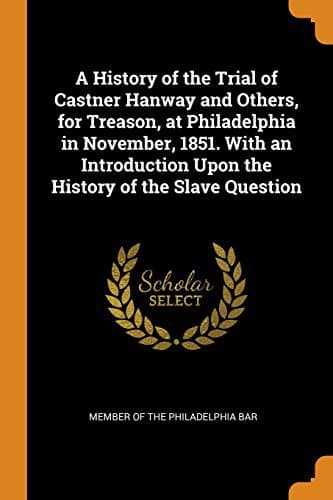
A History of the Trial of Castner Hanway and Others, for Treason, at Philadelphia in November, 1851: With an Introduction upon the History of the Slave QuestionMember of the Philadelphia bar
History
A History of the Trial of Castner Hanway and Others, for Treason, at Philadelphia in November, 1851: With an Introduction upon the History of the Slave Question
Member of the Philadelphia bar
Fugitive slaves -- Legal status, laws, etc. -- United States; Hanway, Castner, 1821-1893 -- Trials, litigation, etc.; Riots -- Pennsylvania -- Christiana; Trials (Treason) -- Pennsylvania -- Philadelphia; United States -- Fugitive slave law (1850)
The constitutionality of this provision, which has since been
adopted by several of the Southern States, has never been judicially
determined. The clause with which it is thought to conflict, is that
which provides, that “the citizens of each State shall be entitled to
all the privileges and immunities of citizens in the several States.”
Now, if residence and the right to be protected in acquiring and
transmitting property under the laws be sufficient to constitute
citizenship, the free negro population of every Northern State would be
entitled to some privileges in the State of Missouri; and, assuredly,
when a party is entitled to exercise certain rights within a given
territory, it can never be legal to deprive him of those rights, by
forbidding him to enter it. And even if these qualifications are
insufficient to constitute citizenship, (a theory which would exclude
a large proportion of the white population in some of the Southern
States,) yet in a few of the free States the right of voting is at
present added to them; and in these cases, at least, if the clause
be not doomed to remain forever a dead letter, it would seem to
find its application. On the other hand, it was urged with great
force, that if the Legislature of a State esteem a certain class of
population dangerous to its existence, it must be entitled by the first
principle of self-preservation--the foundation both of national and
individual existence--to exclude them from its midst. The clause in the
Constitution cannot mean that every citizen of each State is entitled
to become such in every other State. This is notoriously untrue. In
some States freehold qualifications are required for voters; in others
not. In some there are restraints upon the acquisition of property,
which in others do not exist. Where, then, is the line to be drawn
between constitutional and unconstitutional differences? Each State may
determine the qualifications necessary for its voters--why may not one
of them be a peculiar color? Each State may exclude from its borders
the professors of particular occupations, which may be distasteful to
it, or which it may fancy to be dangerous; why not those who have, at
any time, exercised such occupations--which would amount to the same
thing as the exclusion of an obnoxious race?
Public-domain text, read in full here on John Shaqi.
Reviews
Reviews
No reviews yet
Be the first to share your thoughts on this work.
Join the Discussion
Join the discussion
Sign in to leave a comment or review.
Sign InorCreate an account