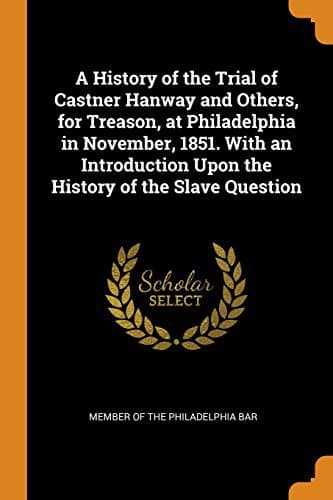
A History of the Trial of Castner Hanway and Others, for Treason, at Philadelphia in November, 1851: With an Introduction upon the History of the Slave QuestionMember of the Philadelphia bar
History
A History of the Trial of Castner Hanway and Others, for Treason, at Philadelphia in November, 1851: With an Introduction upon the History of the Slave Question
Member of the Philadelphia bar
Fugitive slaves -- Legal status, laws, etc. -- United States; Hanway, Castner, 1821-1893 -- Trials, litigation, etc.; Riots -- Pennsylvania -- Christiana; Trials (Treason) -- Pennsylvania -- Philadelphia; United States -- Fugitive slave law (1850)
During a long and troubled session, this intricate question was argued
both by Congress and the people, with a violence unknown before. Mr.
Clay, for a long time, struggled in vain to close the rapidly widening
breach. In vain, his famous Committee of Thirteen reported a series
of compromising resolutions; both sides were too far advanced to
retract, and the platform was angrily rejected. No question, however
insignificant, could be taken up, into which these bitter feelings were
not dragged; the business of the Nation was wholly suspended, while
the contending forces hurled harangues of defiance at each others’
heads, which were re-echoed with equal fury from every village in the
country. A settlement grew more and more hopeless; and, at last, a
formal plan of secession was agreed upon by a minority of the State.
The cry of “_Danger to the Union_” has become so hackneyed of late
years, as to be treated with contempt by rational men of all parties;
but, if ever it had a serious and alarming meaning, it was at the time
we are speaking of. Even President making and President greeting,
failed to drown the dismal foreboding, that soon all Presidents might
be memories of the past. A storm was raised that no one had power to
quell; “the spirits had come from the vasty deep,” and no magician
was found who could charm them back again. At length, by slow and
cautious advances, Mr. Clay again approached the troubled circle;
increased his Committee to twenty-three, representing all the States
of the Union, reasoned with them, exhorted them, entreated them;
brought all those wondrously conciliatory talents with which he was
gifted, to bear personally upon each member he could reach; and after
the most laborious and exhausting efforts, succeeded in passing the
Compromise, which, at last, quieted the Missouri question. It consisted
substantially in referring the subject to the National Judiciary, to
whose province it undoubtedly belonged, and to whose solemn decision
the North should, from the beginning, have been content to leave
it. That it has never been settled by this high authority, and that
we are still unable to answer the apparently simple question--“Who
are citizens of the United States?”--is certainly a very singular
predicament for a great people to be placed in, but one for which the
South are in no way to blame.
Public-domain text, read in full here on John Shaqi.
Reviews
Reviews
No reviews yet
Be the first to share your thoughts on this work.
Join the Discussion
Join the discussion
Sign in to leave a comment or review.
Sign InorCreate an account