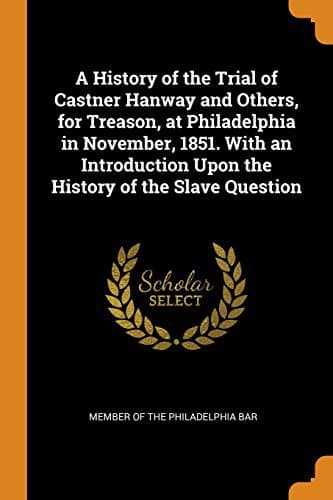
A History of the Trial of Castner Hanway and Others, for Treason, at Philadelphia in November, 1851: With an Introduction upon the History of the Slave QuestionMember of the Philadelphia bar
History
A History of the Trial of Castner Hanway and Others, for Treason, at Philadelphia in November, 1851: With an Introduction upon the History of the Slave Question
Member of the Philadelphia bar
Fugitive slaves -- Legal status, laws, etc. -- United States; Hanway, Castner, 1821-1893 -- Trials, litigation, etc.; Riots -- Pennsylvania -- Christiana; Trials (Treason) -- Pennsylvania -- Philadelphia; United States -- Fugitive slave law (1850)
The violent sectional feeling, however, to which this discussion had
given birth, had sunk too deeply into the hearts of the people to be
eradicated by any Compromise. Its baneful effects have been since
witnessed in the manner in which every great national question has
been debated. We cannot, of course, fill our pages with references to
these really irrelevant matters, nor have we space to follow in all its
developments, the illiberal policy pursued by Congress with regard to
petitions from the North upon this subject. The treatment to which they
have been subjected is generally known, and the reasons for and against
it too well understood to require rehearsing.
During the fifteen or twenty years following, the feeling against
slavery grew constantly stronger in the Northern States, and gradually
assumed a more thoroughly organized character. Anti-Slavery Societies
were formed in the latter part of this period; the all-powerful
machinery of the press was called in to sustain the movement; public
discussions on the subject attracted general attention; and all
possible means were employed, which the leaders of the party could
devise, to propagate their views. The provisions of the Fugitive Law
of 1793 began to be, for the first time, severely commented upon. The
various laws which different States had passed, with a view to its
impartial administration, were strictly scrutinized, and the Act itself
denounced as arbitrary and unconstitutional. The State of Pennsylvania,
unwilling that the freedom of negroes within her borders should be
allowed to depend upon the unassisted judgment of Magistrates of the
lowest jurisdiction, passed an Act in 1826 requiring all such cases to
be heard before the Judges of the County Courts. In 1842, this law was
declared unconstitutional by the Supreme Court, in the celebrated case
of Prigg v. the Commonwealth of Pennsylvania. In consequence of this
decision, the Legislature passed an Act which had already been adopted
in several of the Free States, by which all State Magistrates and
Judges were forbidden to take cognizance of cases of fugitive slaves,
the jails of the State were closed against the masters, and the whole
subject was left to the jurisdiction of Congress, where it properly
belonged.
Public-domain text, read in full here on John Shaqi.
Reviews
Reviews
No reviews yet
Be the first to share your thoughts on this work.
Join the Discussion
Join the discussion
Sign in to leave a comment or review.
Sign InorCreate an account