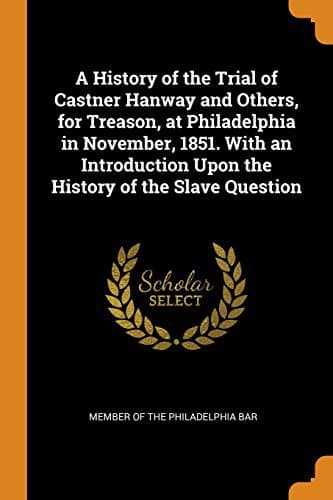
A History of the Trial of Castner Hanway and Others, for Treason, at Philadelphia in November, 1851: With an Introduction upon the History of the Slave Question — John Shaqi
A History of the Trial of Castner Hanway and Others, for Treason, at Philadelphia in November, 1851: With an Introduction upon the History of the Slave QuestionMember of the Philadelphia bar
History
A History of the Trial of Castner Hanway and Others, for Treason, at Philadelphia in November, 1851: With an Introduction upon the History of the Slave Question
Member of the Philadelphia bar
Fugitive slaves -- Legal status, laws, etc. -- United States; Hanway, Castner, 1821-1893 -- Trials, litigation, etc.; Riots -- Pennsylvania -- Christiana; Trials (Treason) -- Pennsylvania -- Philadelphia; United States -- Fugitive slave law (1850)
On the day of the affray it seems that no action was taken at
Christiana for the arrest of any parties. All was confusion. The next
morning (the 12th of Sept.) Kline went before Joseph D. Pownall,
Justice of the Peace of Lancaster County, for the township of Sadsbury,
and on oath charged Elijah Lewis, Castner Hanway, John Morgan, Henry
Simms, Charles Valentine, Lewis Clarkson, Charles Hunter, Lewis Gales,
George Williams, Alson Parnsley, Light Stewart, Hezekiah Clemens,
George Wells, Walter Harris, Abraham Clinch, Nelson Carter and Jacob
Phillips, with “aiding and abetting in the murder of Edward Gorsuch
on the morning of the 11th September, 1851,” and warrants were issued
for their arrest. As soon as Lewis and Hanway heard of this, they went
over to Christiana and surrendered themselves to the authorities. They
and the colored men were carried to Lancaster that night, to await a
further hearing before Alderman J. Franklin Reigart, of the city of
Lancaster.
The next day (the 13th Sept.) the train from Philadelphia brought up
the U. S. District Attorney, J. W. Ashmead; the U. S. Commissioner,
E. D. Ingraham; an Attorney who had acted as counsel for Mr. Gorsuch,
before he applied to Mr. Ingraham in Philadelphia; a company of Marines
from the Navy Yard at Philadelphia; and a number of the Marshal’s
police.
These, it seems, when reinforced by such volunteers as could be
procured from the neighborhood, composed the force by which “the
country was to be scoured.” They went from house to house with
fire-arms in their hands, demanding of the people they met whatever
best suited their fancies.
On the same day at Christiana, the Commissioner heard the charges
against Joseph Scarlett, Wm. Brown, Ezekiel Thompson, Daniel Clarksbury
and Benjamin Pendergrast, and they, with Isaiah Clarkson and Elijah
Clark,[A] were the next day (Sunday) brought to the Moyamensing prison
in Philadelphia, “to await their trial at the next term of the Circuit
Court upon the charge of having committed treason against the United
States.”
On the 15th (Monday) the Commissioner resumed his duties, and heard the
charges against Henry Green, Wm. Williams, John Halliday, Wm. Brown,
(second), George Read, Benjamin Johnson, John Jackson, Thomas Butler,
John Clark, Moses Johnson, Jacob Johnson, Emory Elias, Nero Johnson,
William Henry Morgan, Aaron Wesley, Daniel Jones, William Jackson,
Peter D. Watson and William Chandler. The first eight, in company
with Samuel Williams, were on the same day sent to Moyamensing. What
became of John Clark does not appear. The records of the prison do not
show that he was ever there, and the transcript of the Commissioner’s
dockett does not say he was discharged.
On the 18th September, Collister Wilson was lodged in Moyamensing
prison. It does not appear by whom he was committed.
On Sunday morning (the 14th Sept.) the prisoners who had been taken
to Lancaster, were again brought before Alderman Reigart, but were
remanded until Tuesday the 16th.
Public-domain text, read in full here on John Shaqi.
Reviews
Reviews
No reviews yet
Be the first to share your thoughts on this work.
Join the Discussion
Join the discussion
Sign in to leave a comment or review.
Sign InorCreate an account