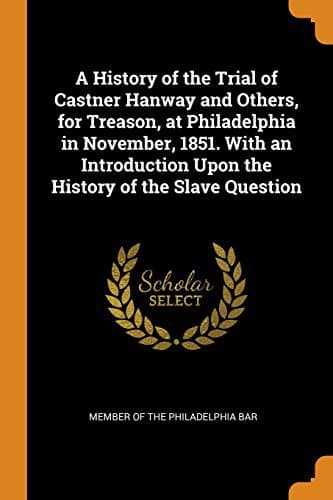
A History of the Trial of Castner Hanway and Others, for Treason, at Philadelphia in November, 1851: With an Introduction upon the History of the Slave Question — John Shaqi
A History of the Trial of Castner Hanway and Others, for Treason, at Philadelphia in November, 1851: With an Introduction upon the History of the Slave QuestionMember of the Philadelphia bar
History
A History of the Trial of Castner Hanway and Others, for Treason, at Philadelphia in November, 1851: With an Introduction upon the History of the Slave Question
Member of the Philadelphia bar
Fugitive slaves -- Legal status, laws, etc. -- United States; Hanway, Castner, 1821-1893 -- Trials, litigation, etc.; Riots -- Pennsylvania -- Christiana; Trials (Treason) -- Pennsylvania -- Philadelphia; United States -- Fugitive slave law (1850)
Before the 16th, it was thought advisable by those in authority, to
change the nature of the charge against the prisoners. They had been
arrested as offenders against the Commonwealth of Pennsylvania. Now
they were to be considered as culprits, to be punished by the laws of
the General Government, and were to be accused as traitors. It was
probably with a view to prepare for this, that, when they were brought
to the appointed place on the 16th, they were again remanded for one
week, until Tuesday the 23d of September.
It is generally considered that a man is safe from prison walls until
it has appeared to a magistrate that there is probable cause for
believing he has committed some offence that should be inquired into
by a jury of his country. Such was the common law of England, and many
believe it to be the common law of this country. The magistrate has
the right, in the exercise of a sound discretion, to detain suspected
parties a _reasonable_ time, while he hears the charges and decides
whether there is necessity for his making a formal commitment. In these
extraordinary cases, however, the operation of the law seemed to be
inconvenient to those who had its initiatory administration, and the
rule was not observed.
Before the appointed time, the company in the prison had been
increased. On the 18th September, Jacob Moore was arrested on process
issued by Squire Pownall.
The prisoners were brought up to Lancaster County Court House about 10
A. M., and the examination began before Alderman Reigart.
Thomas E. Franklin, Esq., John L. Thompson, Esq., District Attorney
for the County of Lancaster, John W. Ashmead, Esq., District Attorney
of the United States for the Eastern District of Pennsylvania, and
R. J. Brent, Esq., Attorney General of the Commonwealth of Maryland,
appeared as counsel to sustain the charges against the prisoners. On
their behalf appeared the Hon. Thaddeus Stevens, George M. Kline,
George Ford and O. J. Dickey, Esqrs.
Twelve witnesses were examined on the part of the United States, and
about the same number on the part of the defence. After two days
deliberation, the Alderman felt it his “duty to commit Castner Hanway,
Elijah Lewis, John Morgan, Henry Simms, Jacob Moore, Lewis Clarkson,
Charles Hunter, Lewis Gales, George Williams, Alson Parnsley, George
Wells, Nelson Carter and Jacob Woods, into the custody of the Marshal
of the U. S. for the Eastern District of Pennsylvania, to answer at the
next session of the U. S. Circuit Court, the charge of having committed
Treason against the United States and aiding and abetting in the murder
of Edward Gorsuch, a worthy citizen of the State of Maryland.” They
were accordingly brought down to the Moyamensing Prison on the 25th of
September.
Reviews
Reviews
No reviews yet
Be the first to share your thoughts on this work.
Join the Discussion
Join the discussion
Sign in to leave a comment or review.
Sign InorCreate an account