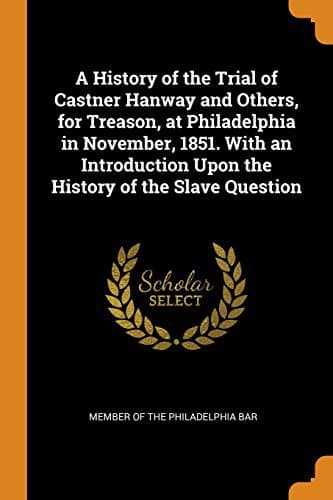
A History of the Trial of Castner Hanway and Others, for Treason, at Philadelphia in November, 1851: With an Introduction upon the History of the Slave QuestionMember of the Philadelphia bar
History
A History of the Trial of Castner Hanway and Others, for Treason, at Philadelphia in November, 1851: With an Introduction upon the History of the Slave Question
Member of the Philadelphia bar
Fugitive slaves -- Legal status, laws, etc. -- United States; Hanway, Castner, 1821-1893 -- Trials, litigation, etc.; Riots -- Pennsylvania -- Christiana; Trials (Treason) -- Pennsylvania -- Philadelphia; United States -- Fugitive slave law (1850)
As a last resort, however, the Carolinas had an argument ready which
defied all ingenuity, learning, or statesmanship to answer, and
which has so often proved potential in after discussions. “North
Carolina would never confederate on any terms that did not rate the
black population at least at three-fifths.” Connecticut generosity
immediately interposed to prevent so disastrous a result, and after
another fruitless effort to obtain an equality of representation,
as some of the members rather metaphorically termed it, for the
luckless slaves, the clause as it now stands was adopted by an almost
unanimous vote. Thus was established the second great compromise of
the Constitution. It is in vain to support it now upon the grounds
which its friends originally occupied. Truer views of the real origin
and real ends of Government, have forever exploded amongst us the
notion, that property can in any way with justice be made an element of
representation; and that article in the Constitution stands now solely
upon any merit which it may have acquired as a necessary concession to
reconcile clashing interests; and it will probably hold its place as
long as slavery exists, upon the simple ground so tersely laid down
at the close of the discussion--that North Carolina would never have
confederated without it.
The course of the debate had, however, clearly shown that the slavery
question was at best nothing but the stalking horse behind which
deeper influences moved; that though the battle cry on one side might
be the rights of man, and on the other the rights of the master, yet
the battle cry in this, as in many other cases, hinted but remotely at
the real grounds of the war. The slaveholding States were at that time
the richest part of the Union, but their wealth arose exclusively from
agriculture, and their interests of course centered in this, and in the
exportation of their products. The Eastern and Middle States, though
then comparatively poor, were clearly destined to be the commercial
power of the Union, though the extent of that commerce and the enormous
wealth of which it has been the source, was then little dreamed of. The
great West was as yet a power unknown, and scarcely foreseen even by
the most sagacious statesmen. The object of the South, therefore, was
to increase their productive power, to give it as great an influence as
possible in the affairs of the country, to leave commerce unfettered,
and especially to exempt exports from the payment of duties. That of
the North, on the other hand, was to give Congress such large powers
in the regulation of commerce, as might be employed in the protection
of their infant marine against foreign competition; and to diminish
the duties on imports. In short it was merely a question as to which
should be the predominating interest--whether the South should be a
huge plantation to be drained of its wealth by the merchant princes
of the North, or whether the northern cities should be nothing but
Public-domain text, read in full here on John Shaqi.
Reviews
Reviews
No reviews yet
Be the first to share your thoughts on this work.
Join the Discussion
Join the discussion
Sign in to leave a comment or review.
Sign InorCreate an account