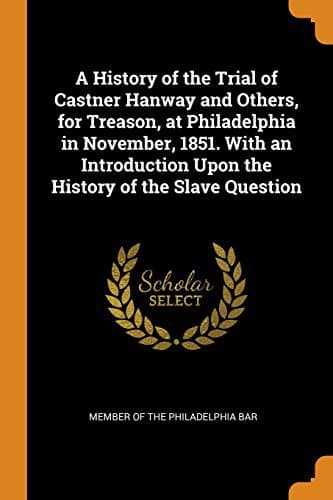
A History of the Trial of Castner Hanway and Others, for Treason, at Philadelphia in November, 1851: With an Introduction upon the History of the Slave QuestionMember of the Philadelphia bar
History
A History of the Trial of Castner Hanway and Others, for Treason, at Philadelphia in November, 1851: With an Introduction upon the History of the Slave Question
Member of the Philadelphia bar
Fugitive slaves -- Legal status, laws, etc. -- United States; Hanway, Castner, 1821-1893 -- Trials, litigation, etc.; Riots -- Pennsylvania -- Christiana; Trials (Treason) -- Pennsylvania -- Philadelphia; United States -- Fugitive slave law (1850)
the trading depots of Southern nabobs. The representation of slaves,
the chief productive element of Southern wealth, was selected as the
test question, and the powers of both parties were developed to the
utter-most in debating it. In the end, the North gained the commercial
privileges upon which it had insisted, the South three-fifths of
the anomalous representation which they demanded, together with the
exemption of exports from taxation. The overwhelming power and wealth
which the North have since acquired, and which must certainly be in
some measure attributed to this early policy, sufficiently proves that
they made an excellent “bargain” as one of their members termed it;
the _morality_ of the arrangement we do not propose to discuss, but
certainly while that compromise, be it good or bad, remains in the
Constitution, the interested work of both parties, it would require the
nicest casuistry to determine which of them is entitled to indulge in
any special self-glorification in the premises.
The second question above stated, acquired great additional importance
from the mode in which the first had been determined; though minor
and more local interests prevailed to alter the arrangement of the
contending forces. The whole of the middle and Eastern States were of
course, both from principle and policy, opposed to the perpetuation of
the slave trade. They had everything to lose and nothing to gain by it.
If this population must needs be represented on the floor of Congress,
certainly their next object was to reduce it to the smallest numbers
possible. But in addition to these very obvious interests, Virginia
and Maryland had other and private reasons for wishing to abolish a
trade which, as their lands were already overloaded by this unhappy
race, could be of no possible service to them, while to some extent it
must deprive them of the ever-extending southern market, into which
their surplus, “annually arising and renewing,” might be profitably
disgorged. Virginia philanthropy was therefore earnest to put an
end to so nefarious a traffic, and its ruinously debilitating and
demoralizing effects were vividly depicted by her talented delegates.
South Carolina and Georgia, whose original swamps were yet unredeemed
from their primeval worthlessness and desolation, and all whose hopes
of future greatness, both political and agricultural, depended on the
increase of this very available population, were sadly dismayed at the
dismal prospect thus suddenly and unfeelingly opened before them by the
desertion of their late allies. In vain they sought to discover, and no
wonder the problem puzzled them, why it should be a damning crime to
buy prisoners of war on the banks of the Niger, but a very laudable and
eminently patriotic course to buy black children and mulattoes bred for
the purpose on the banks of the Potomac.
Reviews
Reviews
No reviews yet
Be the first to share your thoughts on this work.
Join the Discussion
Join the discussion
Sign in to leave a comment or review.
Sign InorCreate an account