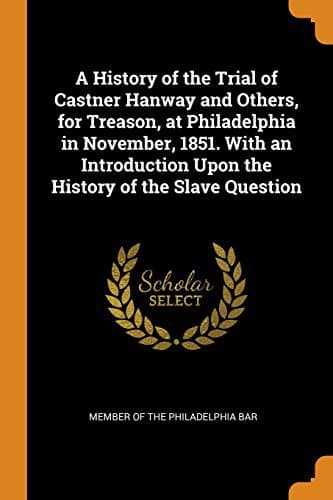
A History of the Trial of Castner Hanway and Others, for Treason, at Philadelphia in November, 1851: With an Introduction upon the History of the Slave QuestionMember of the Philadelphia bar
History
A History of the Trial of Castner Hanway and Others, for Treason, at Philadelphia in November, 1851: With an Introduction upon the History of the Slave Question
Member of the Philadelphia bar
Fugitive slaves -- Legal status, laws, etc. -- United States; Hanway, Castner, 1821-1893 -- Trials, litigation, etc.; Riots -- Pennsylvania -- Christiana; Trials (Treason) -- Pennsylvania -- Philadelphia; United States -- Fugitive slave law (1850)
We would not, however, represent that this question was debated by all
the Northern members with such exclusively interested views as marked
their treatment of the preceding one. Many of them were really alive to
the horrors of a trade which the whole civilized world was beginning to
look upon with detestation, and they protested vehemently against its
toleration under a new and republican government. But South Carolina
was by this time thoroughly versed in that omnipotent logic which
has tied up so many Gordian knots from that time to this. “Religion
and humanity,” said Rutledge, “have nothing to do with the question.
Interest alone is the governing principle with nations. The true
question at present is, whether the Southern States shall or shall not
be parties to the Union.” “South Carolina,” said Cotesworth Pinckney,
“can never receive the plan if it prohibits the slave trade;” and
“Georgia,” echoed Baldwin, “will never become a member of the Union,
if forbidden to import slaves.” Ellsworth, from Connecticut, forthwith
took the alarm--“was afraid of losing two States, while such others as
might be disposed to stand aloof, would fly into a variety of shapes
and directions, and most probably into several confederacies, not
without bloodshed.” This singular imaginary spectacle of States _flying
into a variety of shapes_, which has rambled through the brains of
successive generations, till the genius of the last great compromiser
exalted it into the sublime metaphor of erratic planets rushing madly
from their spheres, of course settled the question at once, and the
slave trade was tolerated till 1808, under the harmless euphemism
of the migration and importation of such persons as any of the then
existing States might think proper to admit.
Whether the controversial resources of the Convention were by this time
exhausted, or whether revolutionary sagacity failed to discover any new
danger to the Union in a clause that in more modern times has proved
a mine of most combustible perils; or whether, as is most likely, the
members saw that the political interests of the two great sections were
in no way staked upon the decision; certain it is, that when, late in
the summer, Mr. Butler suggested the restoration of fugitives from
labor as an amendment to the article providing for the delivering up of
criminals, the only objection offered was that the two clauses seemed
somewhat incongruous. The proposal was withdrawn for the moment and
submitted a few days afterwards by the same gentleman and C. Pinckney.
It was at once agreed to without debate. It is somewhat singular
that so many complaints should have been made of the inadequacy of a
provision thus expressly fashioned by the party it was intended to
benefit, and which is in reality more stringent than the one which,
had it not been for the Northern members, would originally have been
adopted.
Reviews
Reviews
No reviews yet
Be the first to share your thoughts on this work.
Join the Discussion
Join the discussion
Sign in to leave a comment or review.
Sign InorCreate an account