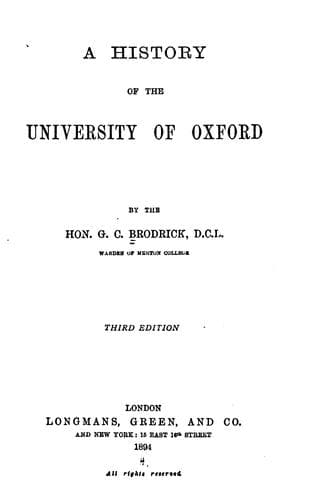
A history of the University of OxfordBrodrick, George C. (George Charles)
History
A history of the University of Oxford
Brodrick, George C. (George Charles)
University of Oxford -- History
really belonged to one of the seven ancient colleges. Considering how
largely the non-collegiate population of the University outnumbered
these small collegiate bodies, it is a very significant fact that so
many vice-chancellors and proctors should have been chosen from them
in days when election to both these offices was entirely free. Such a
fact goes far to prove that the ‘college monopoly,’ of which so much
has been heard in later times, owed its origin, in a great degree, to
natural selection in a genuine struggle for existence between endowed
and unendowed societies.
FOOTNOTES:
[3] In the Merton Statutes the words ‘Scholar’ and ‘Fellow’ are
convertible, the Scholar being a Junior Fellow upon his first admission.
[4] Though Canterbury College was founded in this century, it does
not seem to have ranked with other colleges in the University, and no
vice-chancellor or proctor is recorded to have been elected from it.
CHAPTER III.
PROGRESS OF THE UNIVERSITY IN THE FOURTEENTH CENTURY.
[Sidenote: Europe in the fourteenth century]
The fourteenth century deserves to be regarded as the most progressive
and eventful in the history of the Middle Ages. All the kingdoms of
Europe were engaged in wars, for the most part destitute of permanent
results, yet the work of civilisation went forward with unbroken
steadiness and rapidity. The Spanish monarchies of Castile and Arragon
continued their long struggle for supremacy with each other, and for
national existence with the Mohammedan power at Granada. Germany was
distracted by civil wars and double imperial elections; Italy was torn
asunder by the factions of the Guelphs and Ghibellines. The usurpation
and avarice of the Roman Court produced an all but general revolt
against Papal authority; the seat of the Holy See was transferred
for sixty years to Avignon, and the return of the Pope to Rome was
followed by ‘the Great Schism,’ which lasted fifty years longer; Russia
was subject to the Khan of Kipchak until its southern provinces were
overrun by the hordes of Timur; Poland and Hungary were exhausting
their strength in expeditions against their neighbours or against
Venice, while the Ottoman Turks were advancing into the heart of
Eastern Europe. England was entering upon its purely dynastic crusades
for the possession of the Scotch and French crowns, which, fruitful
as they were in military glory, diverted the energies of the nation,
wasted its resources, and retarded its internal development for several
generations. Nevertheless, literature, art, and education flourished
marvellously in the midst of the storms which racked European society.
Ancient learning was revived in Italy chiefly by the influence of
Petrarch and Boccaccio; Dante became the father of modern Italian
poetry; Cimabue and his pupils founded the Italian school of painting;
scholastic philosophy culminated and gave place to a more independent
spirit of inquiry; scientific research first began to emancipate
Public-domain text, read in full here on John Shaqi.
Reviews
Reviews
No reviews yet
Be the first to share your thoughts on this work.
Join the Discussion
Join the discussion
Sign in to leave a comment or review.
Sign InorCreate an account