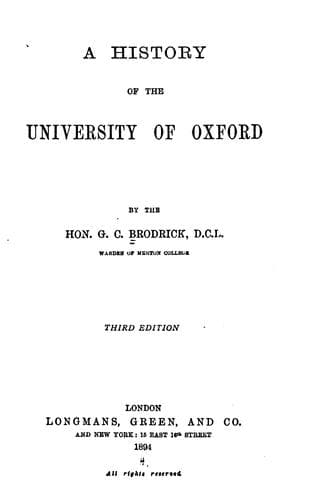
A history of the University of OxfordBrodrick, George C. (George Charles)
History
A history of the University of Oxford
Brodrick, George C. (George Charles)
University of Oxford -- History
itself from magical arts; Roman law extended its dominion everywhere
except in England, where, however, Chaucer and Wyclif gave the first
powerful impulse to native English thought; free thinking in politics
and religion penetrated deeply into the popular mind, and increasing
refinement of manners kept pace with the growth of trade and industry.
Universities sprang up one after another—in France, in Spain, in Italy,
in Poland, in Hungary, in Austria, and in Germany; nor is it unduly
rash to surmise that, if the invention of printing could have been
anticipated by a century, the Renaissance and the Reformation itself
might have preceded the capture of Constantinople and the discovery of
America.
[Sidenote: Social condition of the University]
At the commencement of this century Oxford presented strange contrasts
between the social and the intellectual aspects of its academical life.
The great riot of 1297 was scarcely over, and had left a heritage
of ill-will which bore fruit in the frightful conflict of 1354; the
encounters between the northern and southern nations were of frequent
recurrence, and there was no effective system of University discipline,
while college discipline, still in its infancy, was confined within
the precincts of Merton, University, and Balliol. The common herd of
students, inmates of halls and inns and lodging-houses, were still
crowded together in miserable sleeping-rooms and lecture-rooms, without
domestic care or comfort, and strangers to all those frank and generous
relations which naturally grow up between young Englishmen, especially
of gentle birth, in the kindly intercourse of modern college life.
They often rendered more or less menial services in return for their
instruction, and were sometimes enabled to borrow from the University
Chest; at other times they relapsed into mendicity, and asked for alms
on the public highways. There were no libraries or museums, and the
few books possessed by the University were stored in a vault under St.
Mary’s Church. The laws of health being unknown, and every sanitary
precaution neglected, the city of Oxford was constantly scourged with
pestilence from which members of the University were fain to fly into
neighbouring country villages.
[Sidenote: Intellectual vigour of the University]
Public-domain text, read in full here on John Shaqi.
Reviews
Reviews
No reviews yet
Be the first to share your thoughts on this work.
Join the Discussion
Join the discussion
Sign in to leave a comment or review.
Sign InorCreate an account