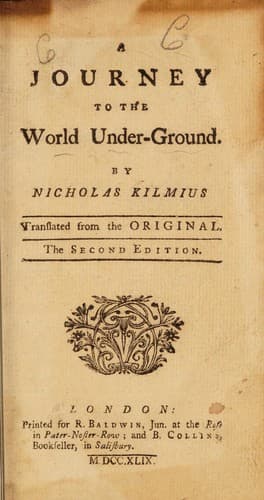
A journey to the world under-groundHolberg, Ludvig
Science
A journey to the world under-ground
Holberg, Ludvig
Utopias -- Early works to 1800; Voyages, Imaginary -- Early works to 1800
The _Potuan_ Empire is of no very great Extent. The whole Globe
is call’d _Nazar_, and is about two hundred _German_ Miles in
Circumference. A Traveller may easily go round it without a Guide,
for the same Language obtains every where, tho’ the _Potuans_ differ
greatly in their Customs and Manners from the other States and
Principalities. And as in our World the _Europeans_ excel the rest of
Mankind, so the _Potuans_ are distinguished by their superior Virtue
and Wisdom from the rest of the Globe. The high Roads, at proper
Distances, are adorn’d with Stones, that mark the Miles, and abound
with Directing-Posts, which shew the Ways and Turnings to every City
and Village. It is indeed a very memorable Circumstance, and worthy of
Admiration, that the same Language is spoke every where, altho’ the
several Kingdoms differ so widely in other Respects, namely, in their
Manners, Understanding, Customs, and Condition, that we see here all
that Variety which Nature delights in, and which does not only simply
move or affect the Traveller, but even throws him into an Extasy of
Wonder.
There are also Seas and Rivers which bear Vessels, whose Oars seem to
be mov’d by a Kind of magick Impulse, for they are not work’d by the
Labour of the Arm, but by Machines like our Clock-work. The Nature of
this Device I cannot explain, as being not well vers’d in Mechanicks;
and besides, these Trees contrive every Thing with such Subtilty, that
no Mortal without the Eyes of _Argus_, or the Power of Divination, can
arrive at the Secret. This Globe, like ours, has a triple Motion,
so that the Seasons here, namely, those of Day and Night, Winter and
Summer, Spring and Autumn, are distinguish’d like ours; also towards
the Poles it grows colder. As to Light, here is little Difference
between Day and Night, for the Reasons before assign’d. Nay, the Night
may be thought more grateful than the Day; for nothing can be conceiv’d
more bright and splendid, than that Light which the solid Firmament
receives from the Sun, and reflects back upon the Planet, insomuch that
it looks, (if I may be allow’d the Expression) like one universal Moon.
The Inhabitants consist of various Species of Trees, as Oaks, Limes,
Poplars, Palms, Brambles, _&c._ from whence the sixteen Months, into
which the subterranean Year is divided, have their Names. For every
sixteenth Month the Planet _Nazar_ returns to its first Station, yet
not upon the same Day, upon account of the Inequality of its Motion;
for just like our Moon, by its manifold _Phases_, it perplexes the
_Literati_ of the Firmament. Their Dates or Æras of Time are various;
these they fix from some memorable Circumstance, and particularly from
the great Comet which appear’d 3000 Years ago, and is said to have
caus’d an universal Deluge, in which the whole Race of Trees, and
other Animals perish’d, except a few which on the Tops of Mountains
escap’d the general Wreck, and from whom the present Inhabitants are
descended.
Public-domain text, read in full here on John Shaqi.
Reviews
Reviews
No reviews yet
Be the first to share your thoughts on this work.
Join the Discussion
Join the discussion
Sign in to leave a comment or review.
Sign InorCreate an account