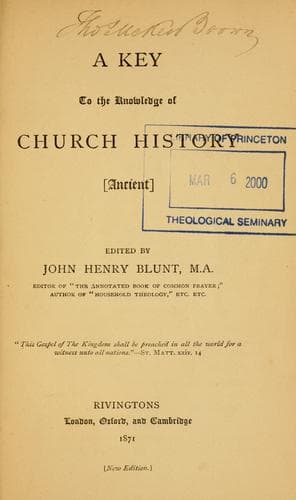
A Key to the Knowledge of Church History (Ancient)Blunt, John Henry
History
A Key to the Knowledge of Church History (Ancient)
Blunt, John Henry
Church history -- Middle Ages, 600-1500; Church history -- Primitive and early church, ca. 30-600
Both these accounts speak to us of their full realization of the
doctrine of the Communion of Saints. They "were together;" they "were
of one heart and of one soul:" the need of one was the need of all;
each felt his brother's wants, as if he himself suffered; and so great
was the liberality of those who had "possessions and goods," that there
was not "any among them that lacked." "They had all things common," as
to the daily use of God's worldly gifts.
[Sidenote: The Holy Eucharist as a Sacrifice]
The Holy Eucharist was to the Church then, as it is still, the chief
act and centre of Divine worship. In this new Sacrifice the Apostles
showed forth and pleaded before God, the One Sufficient Sacrifice,
which they themselves had seen "once offered," with unspeakable
sufferings, and all-prevailing Blood-shedding upon the Cross of
Calvary. [Sidenote: and a means of union with Christ.] In it they
adored Him, Whom they now acknowledged with every faculty of their
souls to be indeed their "Lord" and their "God;" in it they found again
the Real and continual, though invisible, Presence of the Master and
Friend for Whose sake they had forsaken all earthly ties; and by it
they were brought into closer union with Him, than when of old they had
walked and talked with Him beside the Galilean Sea, or beneath the
olive-trees of Gethsemane; for now, they were indeed "nourished and
cherished" by Him and made more and more "members of His Body, of His
flesh, and of His bones[30]." [Sidenote: Thankfulness of the first
converts.] What wonder, then, that we read of the "gladness and
singleness of heart" of the {15} Apostles and their converts thus
living in the constant joy and presence of their Lord, and that
"praising God" is mentioned as one of their distinguishing marks:--
"By 'Deo gratias,' as they pass'd,
The faithful folk were surest known;
That watchword for the daily strife
Might well their thoughts and tongues employ,
Who made the Church transform their life,
And the great Offering crown their joy[31]."
[Sidenote: Continued attendance of the Apostles on the Temple Services.]
We may here remark the many indications which are given us throughout
the Book of Acts, that the Apostles, who were themselves Jews, did not,
even after the Foundation of the Christian Church, oppose or neglect
Jewish ordinances and worship, so long and so far as the union of the
two dispensations was practicable. In this they followed the example
of their Divine Master, Who, from His Circumcision upwards, paid
obedience to that Law which He came to fulfil, and Who was a constant
attendant at the services of the Temple and of the Synagogues. There
was no violent rending away from the old Faith, until God, in His
wisdom and justice, saw fit to ordain the destruction of the guilty
city Jerusalem, and the overthrow of the Jewish Temple, and Altar, and
Priesthood, none of which had then any further purpose to serve in the
Divine plan for the redemption of mankind.
Public-domain text, read in full here on John Shaqi.
Reviews
Reviews
No reviews yet
Be the first to share your thoughts on this work.
Join the Discussion
Join the discussion
Sign in to leave a comment or review.
Sign InorCreate an account