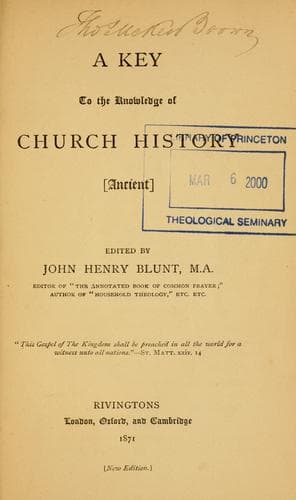
A Key to the Knowledge of Church History (Ancient)Blunt, John Henry
History
A Key to the Knowledge of Church History (Ancient)
Blunt, John Henry
Church history -- Middle Ages, 600-1500; Church history -- Primitive and early church, ca. 30-600
[Sidenote: In the cases of St. Peter and St. John,]
Thus we read of St. Peter and St. John going up to the Temple to
worship at the ninth hour of prayer[32], and of their afterwards
preaching to the people in that part of the {16} Temple called
Solomon's porch[33], of the daily preaching of the Gospel by the
Apostles in the Temple[34], and of their constant resort to the Jewish
Synagogues during their stay in such places as possessed them[35].
[Sidenote: and of St. Paul.] Even five and twenty years after the day
of Pentecost we find that the very tumult which resulted in St. Paul's
apprehension and consequent journey as a prisoner to Rome, was
immediately excited by his having "entered into the Temple[36]," in
performance of one of the ceremonies of the Mosaic Law.
Section 7. _The First Schism and the Appointment of the Diaconate._
[Sidenote: A. D. 33. The first deadly sin in the Church.]
Great and deadly sin had already made its way into Christ's fold, and
been cast out from the midst of it by a fearful judgment. Ananias and
Sapphira had "lied unto God," and been struck dead for their impiety;
and the "great fear" excited by this first display of the judicial
powers of the Church had been followed by another influx of
conversions; for "multitudes were added to the Lord[37]." [Sidenote:
A.D. 34. The first schism.] And now came the first division in the
body, "a murmuring of the Grecians against the Hebrews[38]."
[Sidenote: Distinction between "Grecians" (or Hellenists) and
"Hebrews."]
By the "Grecians" are meant those Jews of foreign birth and education
who had adopted Greek customs and the Greek language so entirely, that
some even of their most learned men did not understand Hebrew {17} but
read the Scriptures of the Old Testament in the Septuagint Version.
They were much despised by the stricter and more narrow-minded
"Hebrews," the natives of Palestine, or Syro-Chaldaic Jews; and the
rivalries of these two Jewish sects were carried even into the bosom of
Christ's Church. [Sidenote: Complaint of the "Grecians."] The
Grecians, or "_Hellenists_" complained that their widows were neglected
in the daily distribution of alms; perhaps grounding their complaint on
the fact that the Twelve were all Hebrews. [Sidenote: Deacons
ordained.] And the Apostles commanded that "seven men of honest report"
should be chosen from the body of believers, and presented to them,
that they might be ordained by Imposition of Hands to minister to the
bodily wants of the poor and aged. This was the first institution of
the Order of Deacons[39], the lowest of the three holy offices which
were to be continually handed down and perpetuated in the Church. Thus
did the Apostles begin to impart to others such a portion of the
ministerial grace, of which they themselves had been at first the sole
recipients, as might enable those whom they ordained to aid them, in a
subordinate degree, in the work of building up the mystical Body of
Christ.
Public-domain text, read in full here on John Shaqi.
Reviews
Reviews
No reviews yet
Be the first to share your thoughts on this work.
Join the Discussion
Join the discussion
Sign in to leave a comment or review.
Sign InorCreate an account