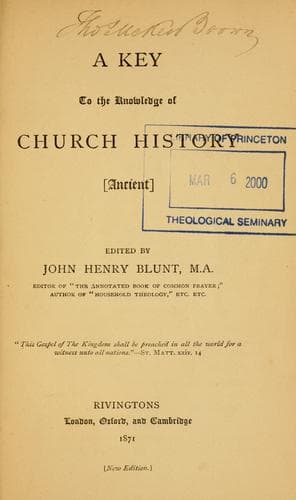
A Key to the Knowledge of Church History (Ancient)Blunt, John Henry
History
A Key to the Knowledge of Church History (Ancient)
Blunt, John Henry
Church history -- Middle Ages, 600-1500; Church history -- Primitive and early church, ca. 30-600
Judging from the names of the Seven Deacons, there seems good reason
for supposing that they were all or most of them Grecians or {19}
Hellenists. St. Stephen was undoubtedly a Hellenist, and his early
training made him a ready instrument for the work to which the Holy
Ghost had called him. Freed by education from many of the associations
and feelings which bound his Hebrew brethren to the Holy City and the
Temple, he could realize more plainly than they could do, the future of
the Christian Church apart from both these, and boldly proclaimed his
convictions. [Sidenote: St. Stephen's preaching rouses Hebrew
prejudices.] By this conduct he aroused all the deeply-rooted
prejudices and exclusive pride of the Jewish mind, even amongst those
who, like himself, were Hellenists, and to whom he seems more
particularly to have addressed himself. Up to this time, what
opposition there was to the teaching of the Apostles, seems to have
come chiefly from the unbelieving sect of the Sadducees[44]; for the
people had espoused the cause of the Christian teachers[45], and the
Pharisees had advocated lenient conduct towards those who confessed, as
they themselves did, a belief in the Resurrection[46]. [Sidenote: The
Pharisees join with the Saducees in opposition to the Church.] But now
all was altered; priests and people, Sadducees and Pharisees, were
alike vehement against those who ventured to assert that the "Holy
Place and the Law" should ever give way to a Holier than they; and
foremost amongst the persecutors was the fiery, earnest, intellectual
man who was afterwards the holy Apostle Paul[47].
[Sidenote: St. Stephen's speech a direct Inspiration.]
The defence of the heavenly-minded Deacon before {20} his malicious and
bloodthirsty enemies must be looked upon as a direct Inspiration of the
Holy Ghost, a fulfilment of our Blessed Lord's promise to His
Church[48], and a Divine commentary on Old Testament History, showing
that God's mercies were not restrained to any particular place or
country, and upbraiding the Jews with their abuse of their many
privileges and their rejection of the Saviour. But the words of this
first Christian "Apology against Judaism" fell for the time on
unheeding ears; and its only present apparent result was the violent
and yet triumphant death of him who had been chosen to utter it.
[Sidenote: His blessed martyrdom.] Beneath the stoning of the enraged
multitude, the First Martyr "fell asleep," blessed in his last moments
with a foretaste of the Beatific Vision[49].
Section 9. _Results of St. Stephen's Martyrdom._
[Sidenote: A.D. 34. Good brought out of evil for the Church.]
Public-domain text, read in full here on John Shaqi.
A Key to the Knowledge of Church History (Ancient) — John Shaqi
Reviews
Reviews
No reviews yet
Be the first to share your thoughts on this work.
Join the Discussion
Join the discussion
Sign in to leave a comment or review.
Sign InorCreate an account