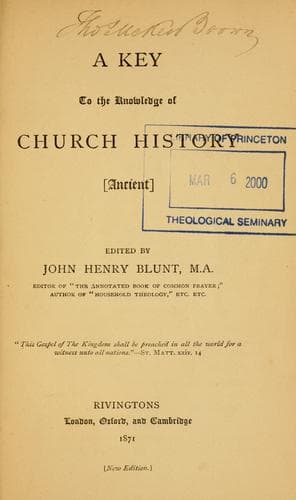
A Key to the Knowledge of Church History (Ancient)Blunt, John Henry
History
A Key to the Knowledge of Church History (Ancient)
Blunt, John Henry
Church history -- Middle Ages, 600-1500; Church history -- Primitive and early church, ca. 30-600
[Sidenote: Increasing conversions.]
This fresh proof of the vitality of the Church through the active,
living Presence of her Divine Head, was followed by a new feature in
the still increasing conversions to her fold. It was no longer the
poor and the unlearned only, or chiefly, who listened to the teaching
of the Apostles, {18} "a great company of the Priests were obedient to
the Faith[40]," while, on the other hand, a growing and more bitter
spirit of persecution was soon to develope itself.
Section 8. _The Martyrdom of St. Stephen._
[Sidenote: A.D. 34. The Seven Deacons.]
St. Stephen, the foremost and saintliest of the Seven Deacons, and St.
Philip, the second in order, are the only two of whom we have any
further mention in the Book of Acts; but it is believed that the last
named, Nicolas of Antioch, was the author of the heresy of the
Nicolaitanes, which our Blessed Lord twice over tells us that He
hates[41]. Nicolas seems in this way to be a sad reflection of the
awful example set by the traitor Judas, the last reckoned Apostle.
[Sidenote: Their functions.]
It is clear that the ministrations of the first Deacons were not of
necessity confined to the "serving of tables," which was the primary
occasion of their appointment. St. Philip both preached and
baptized[42]; and St. Stephen brought down upon himself the hatred and
malice of the Jews by the boldness and power of his preaching. Both
preaching and baptizing do still, under certain restrictions,
"appertain to the office of a Deacon[43]."
[Sidenote: Probably all Hellenists.]
Public-domain text, read in full here on John Shaqi.
Reviews
Reviews
No reviews yet
Be the first to share your thoughts on this work.
Join the Discussion
Join the discussion
Sign in to leave a comment or review.
Sign InorCreate an account