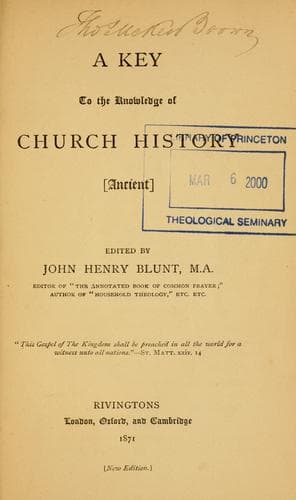
A Key to the Knowledge of Church History (Ancient)Blunt, John Henry
History
A Key to the Knowledge of Church History (Ancient)
Blunt, John Henry
Church history -- Middle Ages, 600-1500; Church history -- Primitive and early church, ca. 30-600
The conversion of the despised city of Samaria was effected by the
instrumentality of the Deacon St. Philip[52], whose preaching and
miracles were followed by the baptism of large numbers of the people,
and, amongst them, of one Simon {22} of Gittum, better known as Simon
Magus (i.e. the magician, or sorcerer), who had claimed supernatural
powers, and given himself out to be an emanation from the Deity, or
even God Himself. [Sidenote: St. Peter and St. John sent to confirm.]
St. Philip, as a Deacon, could not complete the gift begun in Holy
Baptism, and St. Peter and St. John were sent down by the Apostles from
Jerusalem, that they might confirm the Samaritan converts by prayer and
the Imposition of Hands. Confirmation in those early days of the
Church was wont to be accompanied by a bestowal of miraculous gifts of
the Holy Ghost; and the wondrous signs following upon this, the first
Confirmation mentioned in God's history of His Church, led the still
unbelieving Simon to long for the ability to confer similar powers.
[Sidenote: The unbelief of Simon Magus.] He dared to offer money to the
Apostles with this view, and drew from St. Peter such a reproof as for
a time pierced through even the heart which had hardened by an abuse of
holy things. But this penitence was of short duration. He became the
author in the Church of a deadly heresy called Gnosticism, mixing up
what he had learnt of the doctrines of Christianity with heathen
philosophy and sinful living, and making pretence of being endowed with
miraculous gifts. [Sidenote: His end.] This first heretic is said to
have perished miserably whilst endeavouring to fly through the air at
Rome[53], St. Peter praying at the same time that he might no longer be
suffered to hinder the salvation of souls.
{23}
[Sidenote: The Gospel preached in Antioch.]
Another important result of the Sauline persecution was the preaching
of the Gospel in the important city of Antioch by the Greek-speaking
Jews who sought refuge there[54], and who addressed themselves to their
Hellenist countrymen. It was in this city, the third in rank in the
Roman Empire, and afterwards the mother of Gentile Christendom, that
the first branch of the Church speaking Greek as its original tongue,
was now beginning to have its foundation; and it was also here that the
disciples were first called by the honourable name of Christians[55].
Section 10. _The Conversion of St. Paul._
[Sidenote: A.D. 34.]
It has been said "that, to combine the ceremonial shortcoming of the
eunuch with the imperfect faith of the Samaritan, is to arrive at the
admission of the Gentiles[56]." Preparation had been made in both
these instances for the carrying out of the Divine scheme by means of
St. Philip, whose fellow-Deacon had gladly laid down his life in
witnessing to the truth of it; and now God's great instrument for the
conversion of the gentile world was to appear.
[Sidenote: Conversion of Saul.]
Public-domain text, read in full here on John Shaqi.
Reviews
Reviews
No reviews yet
Be the first to share your thoughts on this work.
Join the Discussion
Join the discussion
Sign in to leave a comment or review.
Sign InorCreate an account