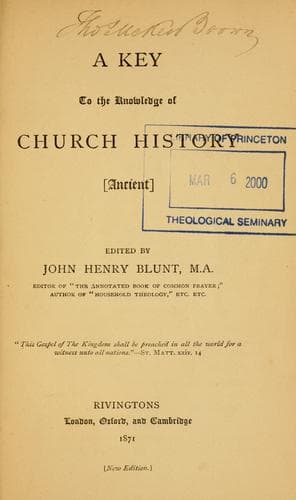
A Key to the Knowledge of Church History (Ancient)Blunt, John Henry
History
A Key to the Knowledge of Church History (Ancient)
Blunt, John Henry
Church history -- Middle Ages, 600-1500; Church history -- Primitive and early church, ca. 30-600
The furious persecutor Saul was struck to the earth by the sight and
voice of the Lord, whose disciples at Damascus he was bent upon
ill-using; and his miraculous conversion was followed by his baptism
and the devotion of all his powers to the promulgation of that "Faith
which once he destroyed."
{24}
[Sidenote: His fitness for his mission.]
It is not hard to perceive in St. Paul a peculiar fitness for the work
to which God called him. His zeal and self-devotion, deep affections,
and warm sympathies, were joined to clearness of judgment and great
intellectual powers; whilst, from the circumstances of his birth and
education, he had much in common with both Hebrew and Hellenist Jews.
Though born in the Greek city of Tarsus, where he came in contact with
the classical ideas and learning of which traces appear in his
writings, his father was a Hebrew, and sent him to finish his education
at Jerusalem under the care of the learned Pharisee Gamaliel. Thus he
became zealous in the Law; and hence his deep tenderness for his
brethren of the seed of Israel, and his thorough insight into their
feelings and prejudices, were united to an acquaintance with gentile
ways of life, classic learning, and foreign modes of thought.
With St. Paul's conversion came a time of peace and increase to the
Church, during which St. Peter's first Apostolic journey took place,
undertaken with the especial view of strengthening, by the Laying on of
Hands and by Apostolic preaching and counsel, those who, throughout
Judea and Samaria, had been regenerated and made "saints" by Holy
Baptism[57].
[1] 2 St. Peter i. 4.
[2] Rev. xxi. 14.
[3] St. Luke vi. 12-16.
[4] "Apostle" is derived from the Greek word "Apostolos," i.e. "one
sent." The Apostles were "sent" by Christ, the Great High Priest and
Chief Pastor of the Church, Who comprehended in Himself the whole of
the Christian Ministry, whilst the Apostolic Office comprehended all
that could be delegated to man. This comprehensive Apostolic Office
was afterwards broken up into the three Orders of--1. Deacons; 2.
Priests and Bishops in one; 3. Bishops. After the special work of
Bishops was defined (see chap. iv.), Priests were Priests only, and not
Bishops, unless they had special consecration to the higher office.
[5] Acts i. 3.
[6] St. John xiv. 26.
[7] St. Matt. xxviii. 19.
[8] St. Matt. xxviii. 20.
[9] St. Luke xxii. 19, 20.
[10] St. John xx. 21, 22.
[11] St. Matt. xxviii. 20.
[12] Acts i. 13, 14.
[13] Acts ii. 42, 46. It is said (St. John iv. 2) that "the disciples
of Jesus baptized;" but this baptism, like that of St. John Baptist,
was a "baptism of _repentance_," not of _Regeneration_--a _preparation_
for the Gospel, not a _consequence_ of it. So the preaching of the
Apostles, spoken of in St. Matt. x. 7, was (like the Baptist's
preaching) an announcement that "the Kingdom of Heaven" was _not come_;
but "at hand," and an exhortation to make ready for it.
[14] St. Luke xxiv. 49.
Public-domain text, read in full here on John Shaqi.
Reviews
Reviews
No reviews yet
Be the first to share your thoughts on this work.
Join the Discussion
Join the discussion
Sign in to leave a comment or review.
Sign InorCreate an account