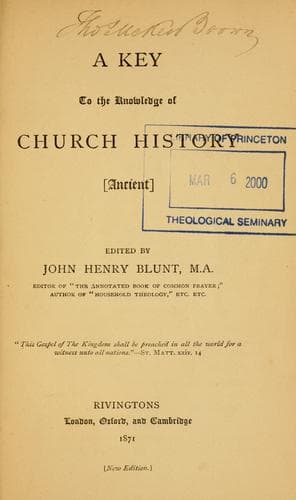
A Key to the Knowledge of Church History (Ancient)Blunt, John Henry
History
A Key to the Knowledge of Church History (Ancient)
Blunt, John Henry
Church history -- Middle Ages, 600-1500; Church history -- Primitive and early church, ca. 30-600
The government of the Church in Jerusalem was conferred on St. James
the Less, perhaps on account of his being "the Lord's brother;" and he
remained in the Holy City as its Bishop, when, about twelve years after
the Day of Pentecost, the other Apostles were for the first time
dispersed beyond the borders of Palestine, over the face of the known
world. The immediate occasion of this dispersion was the persecution
by Herod Agrippa, which resulted in the martyrdom of St. James {28} the
Great[3] and the temporary imprisonment and miraculous deliverance of
St. Peter (A.D. 44), a deliverance granted to the earnest prayers of
the Church.
Section 3. _The Apostolic Church in Antioch._
[Sidenote: A.D. 42. St. Barnabas at Antioch.]
We have no account in the Book of Acts of the Foundation (in the strict
sense of the word) of the Church in Antioch. We read of St. Barnabas
being sent thither from Jerusalem to visit and teach the converts
amongst the Greek-speaking Jews, he being all the more fitted for this
office by his connexion with Cyprus, whence came some of those who had
first spread the knowledge of the Gospel in Antioch. But St. Barnabas
was not yet of the number of the Apostles, the Foundations of the
Church (as neither was St. Paul, whom he lovingly sought out and
brought from Tarsus to aid in his work); and consequently we do not
read that the "laying on of hands" formed any part of their
ministrations. [Sidenote: St. Peter believed to be the founder of the
Church in Antioch.] There is, however, a very ancient tradition which
tells us that St. Peter visited Antioch and founded the Church in that
distant city whilst on his way to the still more distant Rome, after
his miraculous escape from Herod's prison (A.D. 44); and in the ancient
Church of England Feb. 22 was observed in commemoration of "St. Peter's
Throne at Antioch," that is, of his episcopal rule there.
{29}
[Sidenote: Obstacles to the conversion of the gentiles.]
It was some years before the conversion of Cornelius and his gentile
household was followed by any extended proclamation of the good tidings
of the Gospel to the heathen world. It was not God's Will that all
obstacles should be at once cleared away from the onward path of the
Church; and the question of the relation in which the heathen were to
stand to the Law of Moses after their conversion to Christianity,
presented many difficulties. St. Peter and the other Apostles seem to
have waited patiently until God should vouchsafe to show them how these
difficulties might best be overcome; and on the Church in the large
gentile city of Antioch it first devolved to send forth missionaries to
the heathen.
[1] St. Matt. xvi. 16-19.
[2] Acts x. 48. It does not seem to have been the usual custom of the
Apostles to administer Holy Baptism themselves. See 1 Cor. i. 14-17.
Public-domain text, read in full here on John Shaqi.
Reviews
Reviews
No reviews yet
Be the first to share your thoughts on this work.
Join the Discussion
Join the discussion
Sign in to leave a comment or review.
Sign InorCreate an account