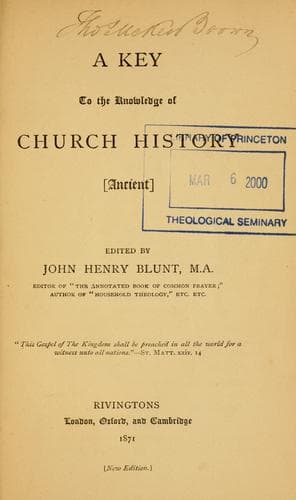
A Key to the Knowledge of Church History (Ancient)Blunt, John Henry
History
A Key to the Knowledge of Church History (Ancient)
Blunt, John Henry
Church history -- Middle Ages, 600-1500; Church history -- Primitive and early church, ca. 30-600
[3] In reference to the martyrdom of St. James, we may remember the
prophecy of his Divine Master (St. Matt. xx. 23). "James tasted the
_first_ draught of Christ's cup of suffering; and his brother John had
the _longest_ draught of it."--Wordsworth on Acts xii. 2.
{30}
CHAPTER III
The Extension of the Church throughout the World
A.D. 45-70
Section 1. _The First Mission to the Gentiles._
[Sidenote: A.D. 45.]
[Sidenote: St. Paul and St. Barnabas sent to preach to the heathen.]
It would seem that in the special Eucharistic offerings and Lenten
discipline mentioned by St. Luke[1], the Church in Antioch was seeking
guidance of her Divine Head as to her duties with respect to the gentile
world in the midst of which she was placed; and that the command of the
Holy Ghost to consecrate St. Paul and St. Barnabas as Apostles to the
heathen was an answer to her cry.
We are not told whose "hands" were "laid" on the two newly-made Apostles
in the solemn Consecration Service which followed, but it is likely that
St. Peter was at that time at Antioch, and also that the Church in that
city was already governed by a Bishop of its own. [Sidenote: They
complete the Apostolic number.] It may here be remarked that the number
of the Apostles was now completed. Those whom they ordained to be {31}
Bishops or Overseers in the Church of God, as St. Timothy at Ephesus, and
St. Titus at Crete, though they received in the "laying on of hands"
power to execute such of the highest offices of the Apostolic function as
were to be perpetually continued to the Church, yet were not fully
Apostles. [Sidenote: Difference between Bishops and Apostles.] They had
grace given to them to confirm, to ordain, and to communicate the power
of ordaining to others, but they were not endowed with the extraordinary
and supernatural gifts bestowed by the Holy Ghost for the Foundation of
the Church; nor did they receive the same direct and outward call as was
vouchsafed to the Twelve by our Lord Himself, and to St. Paul and St.
Barnabas by the special appointment of the Holy Spirit. They were not to
_found_ the Church, but to _build up_ on its Apostolic foundations.
[Sidenote: Mission to Cyprus.]
Public-domain text, read in full here on John Shaqi.
Reviews
Reviews
No reviews yet
Be the first to share your thoughts on this work.
Join the Discussion
Join the discussion
Sign in to leave a comment or review.
Sign InorCreate an account