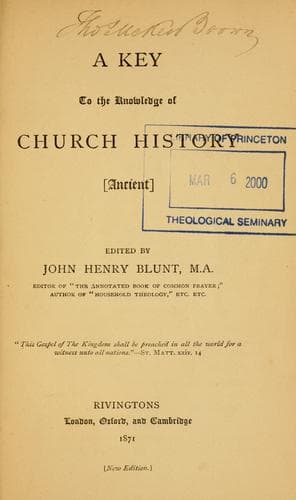
A Key to the Knowledge of Church History (Ancient)Blunt, John Henry
History
A Key to the Knowledge of Church History (Ancient)
Blunt, John Henry
Church history -- Middle Ages, 600-1500; Church history -- Primitive and early church, ca. 30-600
This[4] is the first mention we have of the ordination of Elders, or
Presbyters (or Priests[5], as we are most in the habit of calling them),
though the fact of the existence of such officers has already been hinted
at[6] as well-known and recognized. Thus we see that, as when at first
"the number of the disciples was multiplied," the Apostles delegated part
of their work to the Order of Deacons, so {33} afterwards, when the
Church continued to grow and increase, they provided for her needs by
instituting the Order of the Priesthood, conferring on others, in God's
Name and by His Authority, a larger portion of the ministerial grace they
had themselves received from Him. [Sidenote: Functions of the
Priesthood.] The distinguishing Grace given to those who were called to
the Office of Elder or Presbyter by the "laying on of hands," was, as it
still is, the power of consecrating and offering the Holy Eucharist, that
so, according to St. Paul's words to the Elders of Ephesus, they may
"feed the Church of God[7]," not as in the case of the Deacons, with "the
meat that perisheth," but with "the Bread of God, which cometh down from
Heaven."
[Sidenote: Consecration of Bishops]
Of the Ordination of Bishops[8], apart from the Apostolate, we have no
mention in the Book of the Acts; but that the Apostles did ordain
successors to themselves, so far as their office was to be perpetual in
the Church, we have ample proofs in the Epistles of St. Paul to St.
Timothy and St. Titus. [Sidenote: Their functions.] To both these holy
men, Bishops or Overseers of the Church in Ephesus and Crete
respectively, St. Paul gives injunctions as to their duties, particularly
in ordaining Elders or Priests, the distinguishing work of a Bishop[9].
Section 3. _The First Council of the Church._
[Sidenote: A.D. 46-51.]
For a "long time" after the return of St. Paul and St. Barnabas to
Antioch, with the news that God had, through their {34} instrumentality,
"opened the Door of Faith to the Gentiles," the Church in that city seems
to have continued to flourish in peace and prosperity. [Sidenote:
Difficulties as to the observance of Jewish rites.] But difficulties with
regard to the observance or non-observance by the Gentile converts of the
rite of circumcision and other precepts of the Mosaic law, arose to
disturb this quiet.
[Sidenote: A.D. 52. Hebrew Jews go to Antioch.]
Public-domain text, read in full here on John Shaqi.
Reviews
Reviews
No reviews yet
Be the first to share your thoughts on this work.
Join the Discussion
Join the discussion
Sign in to leave a comment or review.
Sign InorCreate an account