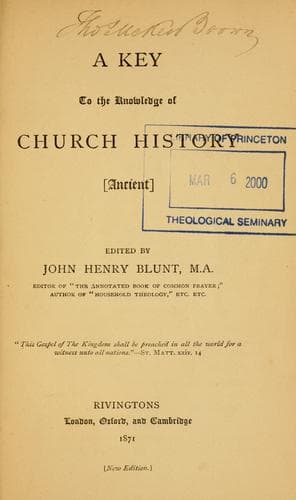
A Key to the Knowledge of Church History (Ancient) — John Shaqi
A Key to the Knowledge of Church History (Ancient)Blunt, John Henry
History
A Key to the Knowledge of Church History (Ancient)
Blunt, John Henry
Church history -- Middle Ages, 600-1500; Church history -- Primitive and early church, ca. 30-600
The Hellenist clergy in Antioch, less wedded to Judaism, had apparently
received into communion, without doubt or question, those amongst the
heathen around the city who had been added to the number of the faithful
by Holy Baptism; but when tidings of this freedom of communion reached
the more severely Hebrew Christians at Jerusalem, certain Hebrew Jews of
them hurried to Antioch, anxious to bring the converts there under the
yoke of the law. Though unauthorized in this mission by the rulers of
the Church in Jerusalem[10], they urged with such persistency the
necessity of circumcision for the salvation of all, that the opposition
of St. Paul and St. Barnabas only raised "no small dissension and
disputation," and it was agreed that the advice of the Apostles and
Presbyters at Jerusalem should be sought on this important question.
[Sidenote: St. Paul and St. Barnabas go to Jerusalem.] St. Paul and St.
Barnabas then, "and certain others with them" (amongst whom was Titus, an
uncircumcised Gentile convert[11]), went up to Jerusalem, where at this
time happened to be St. Peter and St. John, as well as St. James, the
Bishop of that Church[12].
{35}
[Sidenote: The First Council.]
The Apostles and Elders, under the presidency of St. James[13], met
together in the First Council of the Church, a large body of the laity
being also present, not indeed to take part in the discussion, but to
hear it, and to receive and acknowledge the decision arrived at[14].
St. Peter, who had first been commissioned to carry the tidings of the
Gospel to the Gentiles, boldly proclaimed the sufficiency of "the Grace
of the Lord Jesus Christ" for their salvation[15], and St. James, who was
probably himself a very strict observer of the Jewish law, yet did not
hesitate to declare that it had no binding force on those who were not
Jews by birth. [Sidenote: St. James presides as Bishop of Jerusalem.
Decree of the Council.] He, as President of the Council, proposed the
decree to which the rest agreed, and which was in substance, that the
Gentile Christians should be commanded so far to respect Jewish
prejudices as to "abstain from meats offered to idols, and from blood,
and from things strangled," whilst they were also enjoined to keep
themselves from the sin of "fornication," into which the Gentile world
was so deeply sunk.
The decrees of the Council did not enter into or provide any solution of
the minor difficulties connected with the intercourse between Jews and
Gentiles in the Church of Christ. Doubtless "it seemed good to the Holy
Ghost" that these questions should be left to be solved by time and
experience and the general exercise of His Gift of Wisdom.
{36}
[Sidenote: Claim for Divine Authority. Guidance of the Holy Spirit
vouchsafed to General Councils.]
Public-domain text, read in full here on John Shaqi.
Reviews
Reviews
No reviews yet
Be the first to share your thoughts on this work.
Join the Discussion
Join the discussion
Sign in to leave a comment or review.
Sign InorCreate an account