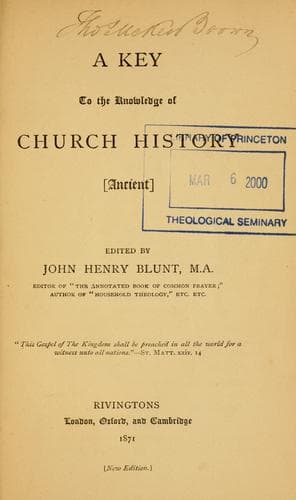
A Key to the Knowledge of Church History (Ancient) — John Shaqi
A Key to the Knowledge of Church History (Ancient)Blunt, John Henry
History
A Key to the Knowledge of Church History (Ancient)
Blunt, John Henry
Church history -- Middle Ages, 600-1500; Church history -- Primitive and early church, ca. 30-600
After founding Churches in the semi-barbarous regions of Phrygia and
Galatia, St. Paul was led by the express direction of the Holy Spirit to
an altogether new field of labour, and it is here, just on the eve of St.
Paul's departure from Asia for the continent of Europe, that St. Luke
joins the Apostolic company. [Sidenote: Jewish influences give way to
Greece and Rome.] The Church was now spreading far westward and coming
into closer contact with the philosophy of Greece and the power of Rome,
whilst Jewish influences shrank into insignificance. There was no
synagogue in the large and important Roman colony of Philippi, {38} and
only women seem to have resorted to the place of prayer outside the walls
of the city, whilst at Thessalonica, where the one synagogue for the
whole district was situated, the accusation of the Jews against the
preachers of the Gospel was no longer of a religious, but of a political
nature. [Sidenote: Opposition to the Gospel political.] "These all do
contrary to the decrees of Caesar[19]." In same way the malice of the
rulers of the Jews against the Divine Head of the Church had found vent
in assertions of His plotting to destroy the Temple, or to make Himself a
King, according as the Jewish populace or the Roman governor was to be
stirred up against Him[20].
But if Jewish prejudices no longer offered the same formidable opposition
to the soldiers of the Cross, as before in Palestine and the neighbouring
countries, the Apostle and his fellow-labourers had now to encounter
fresh enemies not less deadly. [Sidenote: Vice and superstition mixed
with intellectual unbelief.] In the highly civilized cities of Greece
they encountered on the one hand the full tide of heathenism with all its
degrading vices and superstitions, and on the other, Pagan philosophy
with its hard sceptical temper and intellectual pride. Influences such
as these may account for the comparatively small results which seem to
have followed the preaching of St. Paul at Philippi, Thessalonica[21],
and Berea, and the prominence given to women as being more easily touched
by the good tidings of the Gospel. [Sidenote: Open conflict with Satan.]
At Philippi is noticeable the conflict between the visible power of Satan
and the Power of {39} One stronger than he, in the casting out by St.
Paul of the evil spirit of Python from the soothsaying woman. This was
an earnest of the final issue of that great contest between the kingdom
of Satan and the Kingdom of God, which was now beginning in the very
strongholds of darkness, and is to continue to the end of time.
We may also remark the first mention of the title and rights of a Roman
citizen claimed by St. Paul for himself and St. Silas after their illegal
imprisonment.
[Sidenote: A.D. 54. Athenians little inclined to believe.]
Public-domain text, read in full here on John Shaqi.
Reviews
Reviews
No reviews yet
Be the first to share your thoughts on this work.
Join the Discussion
Join the discussion
Sign in to leave a comment or review.
Sign InorCreate an account