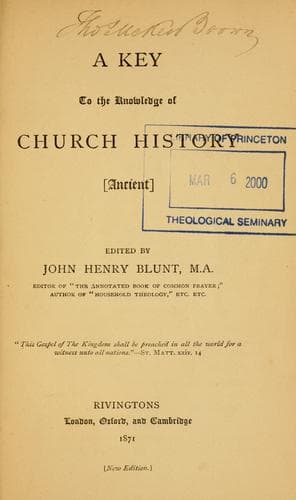
A Key to the Knowledge of Church History (Ancient) — John Shaqi
A Key to the Knowledge of Church History (Ancient)Blunt, John Henry
History
A Key to the Knowledge of Church History (Ancient)
Blunt, John Henry
Church history -- Middle Ages, 600-1500; Church history -- Primitive and early church, ca. 30-600
We can hardly fail to be struck by the confident language in which the
First Council of the Church claims for its decisions the full weight of
Divine Authority; and though it differed from later Catholic Councils in
that it was presided over by inspired men, yet we may well believe that
to those General Councils which really deserved the name, the Holy Spirit
vouchsafed such a special measure of His guiding Power, as might suffice
to preserve their decisions from error, and enable them to hand down
unblemished the deposit of Truth which Christ left with His Church.
Section 4. _St. Paul's Second Apostolic Journey._
[Sidenote: A.D. 53. St. Peter's probable visit to Antioch.]
St. Paul and St. Barnabas bore back to the Church in Antioch the decree
of the Council at Jerusalem, and it was probably about this time that St.
Peter paid to Antioch the visit of which we read in the Epistle to the
Galatians[16], when his fear of "them which were of the circumcision,"
led him to shrink from continuing to eat and drink with the Gentiles, and
drew down St. Paul's stern rebuke. [Sidenote: Separation of St. Paul and
St. Barnabas.] The difference of opinion about St. Mark soon after
separated the two Apostles, whose labours amongst the heathen had been
till now carried on together, and St. Paul began his missionary travels
without an Apostolic companion[17]. He went first through Syria and his
native country Cilicia, {37} "confirming" the baptized, and then to the
scene of his first contact with actual heathendom at Derbe and Lystra.
St. Paul's course of conduct with regard to the circumcision of St.
Timothy, a native of Lystra, shows us clearly how fully his mind had
grasped all the bearings of the question between Jews and Gentiles[18].
[Sidenote: St. Paul's indifference to circumcision in itself.]
Circumcision and uncircumcision were alike matters of indifference to
him, in no way affecting salvation, excepting so far as they might tend
to the edification of others. He did not blame those converted Jews who
still thought it needful to observe the Mosaic law, but he resisted to
the uttermost all attempts to make that law binding on the Gentiles, and
would not sanction any thing which might seem to imply that the
Life-giving ordinances of the Gospel were not sufficient for every need.
St. Timothy, uncircumcised, would have obtained no hearing from Jews for
the Gospel he preached, and therefore he was circumcised as a measure of
Christian expediency.
[Sidenote: St. Paul crosses over to Europe. St. Luke joins him.]
Public-domain text, read in full here on John Shaqi.
Reviews
Reviews
No reviews yet
Be the first to share your thoughts on this work.
Join the Discussion
Join the discussion
Sign in to leave a comment or review.
Sign InorCreate an account