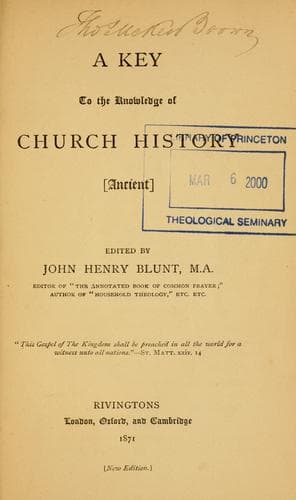
A Key to the Knowledge of Church History (Ancient)Blunt, John Henry
History
A Key to the Knowledge of Church History (Ancient)
Blunt, John Henry
Church history -- Middle Ages, 600-1500; Church history -- Primitive and early church, ca. 30-600
Ephesus was the great seat of the worship of the heathen goddess Diana,
or Artemis, and was also full of those who practised "magical arts" or
sorceries, so that its inhabitants were doubly enslaved by the Evil One.
But the kingdom of darkness could not stand against the Kingdom of Light.
[Sidenote: Great power given to the Church. A.D. 57. A.D. 58.] Great as
was the power of Satan, still more mighty was the Power which the Lord
Jesus gave to His Church. "Special miracles" were wrought in the place
of "lying wonders;" the Jewish exorcists were confounded, and the
sincerity of the Christian converts was proved by the costly sacrifice of
their once-prized books of magic. "So mightily grew the Word of God and
prevailed[24]."
St. Paul passed between two and three years at Ephesus, during which time
he is supposed to have founded the Church in Crete, leaving St. Titus as
its Bishop, whilst Ephesus was placed under the episcopal charge of St.
Timothy. But eventually the riot excited by Demetrius drove the Apostle
from that city. [Sidenote: A.D. 59. A.D. 60.] [Sidenote: His visitation
charge to the Elders of Ephesus.] On his return to the neighbouring city
of Miletus, after his journey through Greece and Macedonia, we read of
his sending to Ephesus for the clergy of that place, and delivering to
them a solemn charge respecting their duties to the flock which God had
entrusted to their care[25].
It is during St. Paul's long sojourn at Ephesus that we have the first
indication of his intention to visit the {42} remoter regions of the
West, and more particularly its capital, imperial Rome[26]. He probably
at that time expected to see its wonders under different circumstances
than those of a prisoner, though before he finished his homeward journey
to Jerusalem, he had supernatural warnings of what was coming upon
him[27] from the malice of his Jewish enemies.
Section 6. _St. Paul at Rome._
[Sidenote: A.D. 60.]
The anxiety which St. Paul ever felt to avoid giving unnecessary offence
to his fellow-countrymen, and his readiness to follow the precepts of
Judaism when they did not interfere with the liberty of Christianity,
were, in God's good Providence, the indirect means of his being sent to
preach the glad tidings of salvation, not in Rome only, but in still more
distant countries. [Sidenote: St. Paul goes to Rome. A.D. 63-65.] It
will not be necessary to enter into the particulars which drew upon St.
Paul the unjust indignation of the Jews, and induced him to appeal from
their persecutions and the popularity-seeking of Festus to the justice of
the emperor: we need only remember that the conclusion of the Book of the
Acts shows him to us a prisoner "in his own hired house" at Rome, and
there preaching and teaching "with all confidence," first, as ever, to
the Jews, and afterwards to the Gentiles.
{43}
Section 7. _Extent of the Labours of the Apostles._
Public-domain text, read in full here on John Shaqi.
Reviews
Reviews
No reviews yet
Be the first to share your thoughts on this work.
Join the Discussion
Join the discussion
Sign in to leave a comment or review.
Sign InorCreate an account