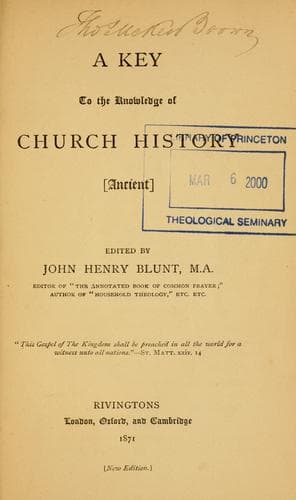
A Key to the Knowledge of Church History (Ancient) — John Shaqi
A Key to the Knowledge of Church History (Ancient)Blunt, John Henry
History
A Key to the Knowledge of Church History (Ancient)
Blunt, John Henry
Church history -- Middle Ages, 600-1500; Church history -- Primitive and early church, ca. 30-600
We are told but little in Holy Scripture as to the particulars of the
Apostles' work in founding the Church of God, except in the case of St.
Paul, and we are not allowed to trace even his labours to their end.
[Sidenote: Preaching of the Apostles in all known countries.] From other
sources we learn that the twelve visited almost every known country of
the world, so as to give to each separate race of men then existing an
opportunity of refusing or accepting the offer of the salvation of which
they were the ministers and stewards. We are also told that all, except
St. John and perhaps St. Matthew, crowned their life of toil in the
service of their Lord by a martyr's death. St. Peter and St. Paul both
suffered at Rome in the First Persecution under Nero, and most likely on
the same day, A.D. 67.
The following Table[28] will show the probable field of the labours of
each Apostle, so far as the record of it has come down to us:--
{44}
Supposed Fields of Apostolic Labour.
Name of Churches. By whom Founded.
Palestine and Syria All the Apostles.
Mesopotamia (Turkey in Asia) St. Peter and St. Jude.
Persia St. Bartholomew and St. Jude
India St. Bartholomew and St. Thomas.
Thrace (Turkey in Europe) St. Andrew. The flourishing
Church of Constantinople
afterwards sprang up on this
field of his labours.
Scythia (Russia) St. Andrew.
North Africa (Egypt and St. Simon Zelotes. St. Mark
Algeria) specially connected with
Alexandria.
Ethiopia (Central Africa). St. Matthew.
Arabia. St. Paul.
Asia Minor (Turkey in Asia) St. Paul and St. John.
Macedonia (Turkey in Europe) St. Paul
Greece St. Paul.
Italy St. Peter and St. Paul.
Spain St. Paul.
Gaul (France) and Britain St. Paul and St. Joseph of
Arimathea.
[1] Acts xiii. 2.
[2] The _first_ offers of salvation continued to be made to the Jews,
even after the recognition by the Church of her mission to the Gentiles.
[3] Acts xiii. 48, 49, 52; xiv. 1.
[4] Acts xiv. 23.
[5] "presbyter," afterwards shortened into "Prester" and "Priest," is
derived from the Greek word "Presbyteros," "an Elder."
[6] Acts xi. 30.
[7] Acts xx. 28.
[8] The word "Bishop" is derived from the Greek "Episcopos," and
signifies an overseer.
[9] 1 Tim. v. 1, 19, 22. 2 Tim. i. 6. Titus i. 5; ii. 15.
[10] Acts xv. 24.
[11] Gal. ii. 3.
[12] Gal. ii. 9.
[13] St. James, as Bishop of the Diocese, taking precedence in this
instance even of St. Peter.
[14] Compare Acts xv. 6. 12.
[15] This is the last mention of St. Peter in the Book of Acts.
[16] Gal. ii. 11-14.
Public-domain text, read in full here on John Shaqi.
Reviews
Reviews
No reviews yet
Be the first to share your thoughts on this work.
Join the Discussion
Join the discussion
Sign in to leave a comment or review.
Sign InorCreate an account