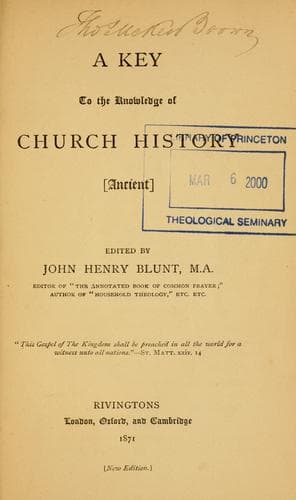
A Key to the Knowledge of Church History (Ancient)Blunt, John Henry
History
A Key to the Knowledge of Church History (Ancient)
Blunt, John Henry
Church history -- Middle Ages, 600-1500; Church history -- Primitive and early church, ca. 30-600
[17] Acts xv. 36-41. The last mention of St. Barnabas in the Book of
Acts.
[18] Compare Acts xvi. 3; and Gal. ii. 3, 4.
[19] Acts xvii. 7. Comp. Acts vi. 11.
[20] Comp. St. Mark xiv. 58; and St. Luke xxiii. 2.
[21] Both Philippi and Thessalonica eventually became the seats of
flourishing Christian Churches, to whom St. Paul wrote Epistles.
[22] Acts xvii. 16-33.
[23] There are some reasons for thinking that men of cultivated minds and
high social position were preferred for Bishops in the early as well as
in later ages of the Church.
[24] Acts xix. 1-20.
[25] Acts xx. 17-35.
[26] Acts xix. 21.
[27] Acts xx. 23; xxi. 11.
[28] From Blunt's "Household Theology."
{45}
CHAPTER IV
Final Settlement of the Church by St. John
A.D. 67-100
It seems probable that most of the Apostles had entered into rest
before the Destruction of Jerusalem, A.D. 70, and that St. John the
Divine was the only one of the Apostolic body who long survived that
event.
[Sidenote: St. Peter began to found the Church, St. John completed its
foundation.]
To St. Peter, one of the "pillars" of the Church, it had been given to
begin the great work of laying the foundation of the Mystical Temple of
God; to St. John, the other of the two, was allotted the task of
perfecting what had been begun, so that a sure and steady basis should
not be wanting on which the New Jerusalem might rise through time to
eternity[1].
{46}
Section 1. _Second Council at Jerusalem._
[Sidenote: A.D. 67.]
[Sidenote: Purposes of the Second Council.]
There is good reason for believing[2] that after the martyrdoms of St.
Peter, St. Paul, and St. James, the first Bishop of Jerusalem, and
about the time of the invasion of the Holy City by Vespasian, a Second
Council of such of the Apostles as still survived was held for the
purpose of electing a successor to the See of Jerusalem, and definitely
settling the future government of the Church. [Sidenote: Bishops only
rarely appointed at first,] Bishops had already been consecrated in
certain cases, as at Ephesus, Crete, and Rome; but during the time that
the Apostles were still engaged in founding and governing the different
branches of the great Christian community, the appointment of Bishops
(in the sense of heads of the Church) seems to have been the exception
rather than the rule. [Sidenote: but now everywhere to replace the
Apostles.] A new era was, however, now coming upon the Church; her
Founders were gradually being withdrawn from her, and it was necessary
that she should receive such a complete and permanent organization as
would enable her to transmit to succeeding ages the saving grace of
which the Apostles had been the first channels, that so what had been
founded through their instrumentality might be continued and extended
through the ministry of others.
{47}
[Sidenote: The establishment of the Apostolical Succession the special
work of St. John,]
Public-domain text, read in full here on John Shaqi.
Reviews
Reviews
No reviews yet
Be the first to share your thoughts on this work.
Join the Discussion
Join the discussion
Sign in to leave a comment or review.
Sign InorCreate an account