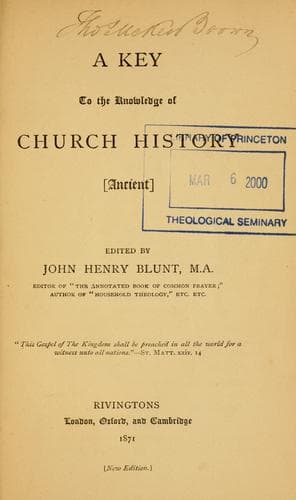
A Key to the Knowledge of Church History (Ancient)Blunt, John Henry
History
A Key to the Knowledge of Church History (Ancient)
Blunt, John Henry
Church history -- Middle Ages, 600-1500; Church history -- Primitive and early church, ca. 30-600
{49} respecting the Faith of the Church. [Sidenote: Development of the
teaching of the Church.] Held firmly in its fulness from the beginning,
it was yet only gradually set forth in Creeds, Liturgies, and
Definitions of Faith, according as the love and belief of Christians
required expression, or the errors of heretics drew forth clearer
teaching on the truths they attacked. [Sidenote: Reserve in the
teaching of the Church.] To this we may add, that the early Church was
very careful to keep the knowledge of the deep mysteries of the Faith
from those who were not Christians. It was only after their initiation
by Holy Baptism that those who had, as Catechumens, been instructed in
the rudiments of Christian doctrine, were admitted to a full knowledge
of the belief and practice of the Church, especially as regarded the
Holy Eucharist, which was very commonly spoken of under the name of the
Holy Mysteries.
Section 3. _St. John at Ephesus[5]._
[Sidenote: St. John's work at Ephesus.]
About the time that Jerusalem was besieged by the armies of Vespasian
(A.D. 67), St. John withdrew to Ephesus (whence for a while he was
banished to Patmos by the Emperor Domitian[6]); and from this city he
travelled about through the neighbouring country, organizing, amongst
others, those Seven Churches of Asia Minor, to whose Angels or Bishops
he was bidden to write the Seven Epistles contained in the Apocalypse.
{50}
[Sidenote: Fitness of Ephesus as a centre of organization,]
Here in Ephesus, the eye of Asia, the great mercantile seaport of the
then known world, his influence could most easily make itself felt
amongst the far-off members of the Christian body, which by this time
had extended throughout the whole Roman empire. All the civilized
world was then subject to the sway of Rome, except India and China; and
it may be that even these two latter countries were not excluded from
the influence of the Gospel. It is not, of course, meant that
Christianity was the recognized religion of all or any of the Roman
provinces; but that in each of them the Church had a corporate
existence, and was a living power, drawing into herself here one, and
there another of the souls who were brought into contact with her, and
really, though gradually, spreading through and leavening the earth.
[Sidenote: and of orthodox teaching.]
Public-domain text, read in full here on John Shaqi.
Reviews
Reviews
No reviews yet
Be the first to share your thoughts on this work.
Join the Discussion
Join the discussion
Sign in to leave a comment or review.
Sign InorCreate an account