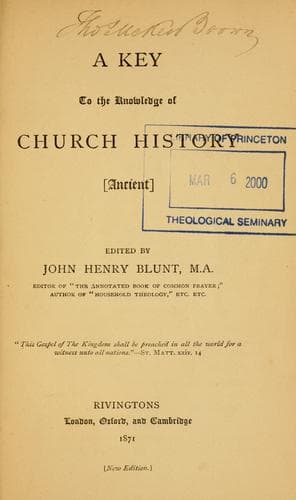
A Key to the Knowledge of Church History (Ancient)Blunt, John Henry
History
A Key to the Knowledge of Church History (Ancient)
Blunt, John Henry
Church history -- Middle Ages, 600-1500; Church history -- Primitive and early church, ca. 30-600
Again, at Ephesus St. John could best combat and confute, both by his
words and writings, the subtle and deadly heresies which were
especially rife there. "False Christs," such as Simon Magus, the first
heretic, Menander, Dositheus, and others, no longer troubled the Infant
Church with their blasphemous impostures, but in their stead false
teachers had arisen, seeking to "draw away disciples after them" into
the more subtle error of misbelief about our Lord and His Incarnation.
[Sidenote: Errors of the Corinthians.] [Sidenote: The Docetae, and
other variations of Gnosticism.] Thus the Jew Corinthus taught that
Christ was a mere man, born like other men, though united to Divinity
from His Baptism to His Crucifixion; whilst to the errors of the
Corinthians the Docetae added that the Body in which our Blessed
Saviour suffered, was only a phantom, and a body but in appearance;
both these heresies, {51} and others of a similar nature, appear to
have been variations of that Gnosticism to which St. Paul refers in his
Epistles, as "science" (or gnosis) "falsely so called[7]," and which
was long a source of danger and trouble to the Church. Gnosticism may
be traced back to that Simon Magus, with whom St. John first came in
contact at Samaria, and in all its varied distortions of the great
Catholic doctrine of the Incarnation, through an admixture of Jewish
and heathen error, there was always an unvarying denial of our Lord's
Divinity.
[Sidenote: St. John's universal patriarchate.]
For about a third of a century St. John continued to exercise a kind of
universal patriarchate over the Church, being regarded, we cannot
doubt, with almost unbounded reverence and affection by all its
members, and perhaps first presenting that idea of one visible earthly
head of the Church, which afterwards found its expression in the
popedom.
Section 4. _St. John's Writings._
[Sidenote: St. John's writings close the Canon.]
The Gospel, Epistles, and Revelation of St. John, written as they were
at a long interval after the rest of the New Testament, and closing the
Canon of Sacred Scripture, may be usefully referred to, as giving us
some idea of the appearance of the Church when its government and
theology were finally settled.
[Sidenote: How his Gospel differs from the other three.]
Public-domain text, read in full here on John Shaqi.
Reviews
Reviews
No reviews yet
Be the first to share your thoughts on this work.
Join the Discussion
Join the discussion
Sign in to leave a comment or review.
Sign InorCreate an account