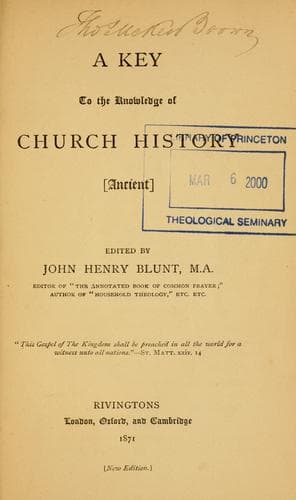
A Key to the Knowledge of Church History (Ancient)Blunt, John Henry
History
A Key to the Knowledge of Church History (Ancient)
Blunt, John Henry
Church history -- Middle Ages, 600-1500; Church history -- Primitive and early church, ca. 30-600
St. John's Gospel differs from those of the other three Evangelists in
having been written for men who from their infancy had grown up in the
Faith of Christ, and who {52} were thus more ready to enter into and
profit by deep sacramental doctrine; whilst at the same time the
dangerous heresies which were beguiling souls from the truth, called
for more detailed and dogmatic teaching than had at first been needed.
[Sidenote: Dwells on our Lord's Divinity,] Hence in place of an account
of our Lord's Human Birth, St. John sets forth His Eternal Godhead and
wonderful Incarnation, leaving no space for unbelief or cavil, when he
proclaims for the instruction of the Church, that "the Word was God,"
and yet that He also "was made Flesh." [Sidenote: and on the two
Sacraments.] Again, the last Gospel does not bring before us the
Institution of the two great Sacraments of the Christian Covenant;
though it, and it alone, does record the teaching of our Blessed Lord
Himself with regard to the New Birth in Holy Baptism, and the constant
Nourishment of the renewed life in the Holy Eucharist.
[Sidenote: The Epistles correct heresies.]
Having established the Faith in His Gospel, St. John in his Epistles
sternly censures heresy and schism, thus witnessing to the end of time
that the charity of the Church must never lead her to countenance false
doctrine.
[Sidenote: The Apocalypse sets forth Discipline and Worship.]
We may look to the Book of the Revelation for some light as to the
discipline and worship of the Church of St. John's days. We have there
in the mention of the Seven Angels or Bishops, each ruling over his own
Church and answerable for its growth in holiness, a confirmation of the
fact that episcopacy was now fully _organized_ as the one form of
Church government which had replaced the extinct hierarchy of the
former dispensation. Nor does it seem unreasonable to believe that St.
John's vision of the Worship of Heaven {53} was intended to supply to
the Christian Church a model to be copied so far as circumstances
should permit in the courts of the Lord's House on earth, much as the
elaborate system of Temple Worship, which was entirely swept away with
the destruction of Jerusalem, had been in all things ordered "according
to the pattern" which the Lord had "showed" first to Moses and
afterwards to David. That the Primitive Church did thus consider the
Heavenly Ritual set forth in the Apocalypse as the ideal of worship on
earth, is proved by the accounts which have come down to us of the
arrangement of Churches and the manner of celebrating the Holy
Eucharist in early times.
[Sidenote: Arrangement of Churches in primitive times.]
Public-domain text, read in full here on John Shaqi.
Reviews
Reviews
No reviews yet
Be the first to share your thoughts on this work.
Join the Discussion
Join the discussion
Sign in to leave a comment or review.
Sign InorCreate an account