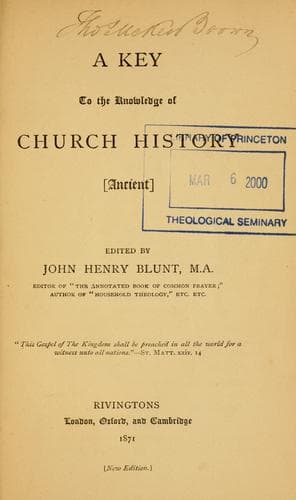
A Key to the Knowledge of Church History (Ancient)Blunt, John Henry
History
A Key to the Knowledge of Church History (Ancient)
Blunt, John Henry
Church history -- Middle Ages, 600-1500; Church history -- Primitive and early church, ca. 30-600
and embracing the highest mystery of Divine Worship, giving 'glory and
honour and thanks to Him that sat on the Throne, who liveth for ever
and ever.' In the succeeding chapter St. John beholds Him for whom
this altar is prepared. 'I beheld, and lo, in the midst of the Throne,
and of the four living creatures, and in the midst of the elders, stood
a Lamb as It had been slain, having seven horns and seven eyes, which
are the seven spirits of God sent forth into all the earth.' It cannot
be doubted that this is our Blessed Lord in that Human Nature on which
the _septiformis gratia_ was poured without measure; and that His
appearance in the form of 'the Lamb that was slain to receive power,
and riches, and wisdom, and strength, and honour, and glory, and
blessing,' represents the mystery of His prevailing Sacrifice and
continual Intercession. But around this living Sacrifice there is
gathered all the homage of an elaborate ritual. They who worship Him
have 'every one of them harps' to offer Him the praise of instrumental
music; they have 'golden vials full of incense, which are the prayers
of saints,' even as the angel afterwards had 'given unto him much
incense, that he should offer it with the prayers of the saints upon
the golden altar which was before the Throne;' they sing a new song,
mingling the praises of 'the best member that they have' with that of
their instrumental music; and they fall down before the Lamb with the
lowliest gesture of their bodies in humble adoration. Let it {56} also
be remembered that one of the Anthems here sung by the Choirs of Heaven
is that sacred song, 'Holy, Holy, Holy, Lord God Almighty, which was,
and is, and is to come;' the Eucharistic use of which is traceable in
every age of the Church[9]."
The ritual of the early Church naturally gathered round the Holy
Eucharist as the central act of worship in which the Lord was most
especially present, and therefore to be most especially honoured. From
the first days of the Church this had been the one distinctively
Christian service; and now that the Temple services had ceased, it
became more apparently even than before, the fulfilment and
continuation of the sacrifices of the elder dispensations[10]: whilst
it was also the Memorial of the Sacrifice of the Cross and the
Representation on earth of the continual offering-up of "the Lamb as It
had been slain," before the Throne of God in Heaven.
[1] St. Peter and St. John had been specially trained by their Divine
Master for their special work. They with St. James, the first
Apostolic martyr, had witnessed His Transfiguration, His Agony, His
raising of Jairus's daughter, and had been admitted into more intimate
communion with Him than the other Apostles.
[2] From passages in the works of St. Irenaeus and Eusebius. See "Some
Account of the Church in the Apostolic Age," by Professor Shirley, pp.
136-140.
Public-domain text, read in full here on John Shaqi.
Reviews
Reviews
No reviews yet
Be the first to share your thoughts on this work.
Join the Discussion
Join the discussion
Sign in to leave a comment or review.
Sign InorCreate an account