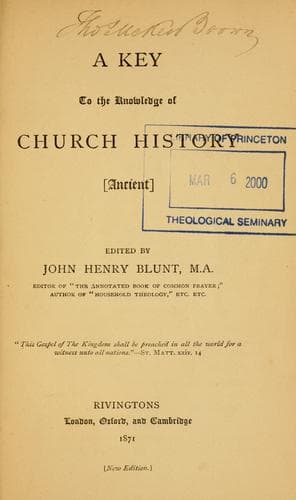
A Key to the Knowledge of Church History (Ancient)Blunt, John Henry
History
A Key to the Knowledge of Church History (Ancient)
Blunt, John Henry
Church history -- Middle Ages, 600-1500; Church history -- Primitive and early church, ca. 30-600
[3] The Apostles appear to have believed at first that our Lord's
Ascension would be very speedily followed by His triumphal return to
Judgment, and the glorification of His faithful people.
[4] On this point we may remember that St. John, who saw deepest into
the Divine Life, did not write his Gospel till near the end of his
earthly labours, almost sixty years after the Day of Pentecost.
[5] Ephesus is known to this day by the name of Aya-soluk, from Agios
Theologos, or holy Divine, the title given to St. John.
[6] Or perhaps by Nero, as some ancient writers say. Nero's full name
was Nero Claudius Domitianus, which may have caused this confusion.
[7] 1 Tim. vi. 20.
[8] As St. Chrysostom says, "When thou beholdest the curtains drawn up,
then imagine that the heavens are let down from above, and that the
Angels are descending."
[9] Annotated Book of Common Prayer, Ritual Introduction, pp. xlix, 1.
[10] We are told that St. John adopted the vestments of the High Priest
of the old covenant, and especially "the plate of the holy crown," with
its inscription, "Holiness to the Lord," thus exhibiting very forcibly
the continuity of the two priesthoods.
{57}
CHAPTER V
The Primitive Church
A.D. 100-A.D. 312
[Sidenote: Persecution increases round the Church.]
We have already had occasion to notice the beginnings of the
persecution which the Church was to undergo for the sake of her Head
and Spouse, not only those of a local and unorganized character, which
are spoken of in the Book of Acts, but also some of a more cruel and
systematic nature under the Roman Emperors Nero and Domitian. From the
death of the last of the Apostles to the conversion of the Emperor
Constantine, A.D. 312, the Church passed through a succession of fierce
trials, in which her members were called to undergo similar sufferings
to those which had been borne by the holy Apostles St. Peter, St. Paul,
and St. John, and their fellow-martyrs[1].
Section 1. _Causes of Persecution._
In considering the causes which led to the persecution of the Church by
the heathen around her, we {58} must, of course, place first as the
root and ground of all, the malice of Satan, and his hatred of God, and
of the means appointed by God for saving souls. [Sidenote: Satan's
enmity the great cause of persecution.] The Kingdom of God and the
kingdom of Satan must ever be at war, and the fierce and varied
sufferings inflicted by the cruel heathen on all who bore the name of
Christ were so many assaults of the great adversary seeking to
overthrow the Church in an open and deadly struggle. But the
life-giving Presence of her Incarnate Lord, and "the patience and the
faith of the Saints," were mightier weapons than "all the fiery darts
of the Wicked," and "the gates of Hell" were not suffered to "prevail
against her."
[Sidenote: Other minor causes.]
Public-domain text, read in full here on John Shaqi.
Reviews
Reviews
No reviews yet
Be the first to share your thoughts on this work.
Join the Discussion
Join the discussion
Sign in to leave a comment or review.
Sign InorCreate an account