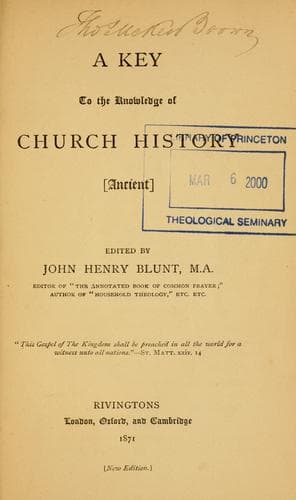
A Key to the Knowledge of Church History (Ancient)Blunt, John Henry
History
A Key to the Knowledge of Church History (Ancient)
Blunt, John Henry
Church history -- Middle Ages, 600-1500; Church history -- Primitive and early church, ca. 30-600
There were, however, other and secondary causes which led to the
persecution of the Church. The Romans were not usually intolerant of
religions which they did not themselves profess; their worship of their
own false gods had come to be a form, as far as the educated classes
were concerned, and what belief they had was given to philosophy rather
than religion. Hence they were not unwilling that the nations they
conquered should keep to their own respective creeds and religious
ceremonies, so long as they did not interfere with Roman authority.
But the religion of Christ required more than this. It could not be
confined to any one country, nor be content with bare toleration, nor
rank itself with the many forms of Pagan misbelief. It claimed to be
the only True Religion, the only Way of Salvation, before which the
superstitions of the ignorant, and the philosophy of the learned must
alike give way. It made its way even into "Caesar's household."
Besides this, Christians, owing to the nationality of the First
Founders {59} of the Church, were often confounded with, and called by
the same name as the Jews, who had a bad repute under the empire for
rebellious and seditious conduct, and we know how, even in the days of
St. Paul, the charge of sedition had begun to be most unjustly fastened
upon the followers of the Meek and Lowly Jesus. This charge of
disaffection to the powers of the state received an additional and
plausible colouring from the fact that the consciences of the faithful
members of the Church would not suffer them to pay, what they and the
heathen around them considered to be Divine honour, to the emperor or
the heathen deities, by sacrificing a few grains of incense when
required thus to show their loyalty to their ruler and his faith. Over
and over again was this burning of incense made a test by which to
discover Christians or to try their steadfastness, and over and over
again was its rejection followed by agonizing tortures and a cruel
death.
[Sidenote: Nero's persecution.]
The persecution in the reign of Nero is immediately traceable to the
accusation brought against the Christians by the emperor, that they had
caused the terrible fire at Rome, which there seems little doubt was in
reality the result of his own wanton wickedness, whilst that under
Domitian appears to have been connected with the conversion of some of
the members of his own family, his cousin Flavius Clemens being the
first martyr sacrificed in it.
Section 2. _Number and Duration of Persecutions._
The following table[2] will show how the early days of the Church were
divided between times of persecution and intervals of rest.
{60}
_Chronological Table of Persecutions and Intervals of Rest._
A.D.
64-68. Persecution under Nero. Martyrdom of
St. Peter and St. Paul.
68-95. Time of peace.
95-96. Persecution under Domitian. Banishment of
St. John.
96-104. Time of peace.
Public-domain text, read in full here on John Shaqi.
Reviews
Reviews
No reviews yet
Be the first to share your thoughts on this work.
Join the Discussion
Join the discussion
Sign in to leave a comment or review.
Sign InorCreate an account