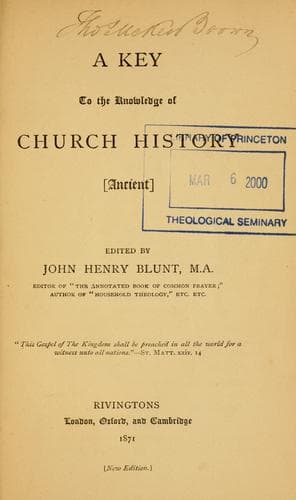
A Key to the Knowledge of Church History (Ancient)Blunt, John Henry
History
A Key to the Knowledge of Church History (Ancient)
Blunt, John Henry
Church history -- Middle Ages, 600-1500; Church history -- Primitive and early church, ca. 30-600
Another natural effect of persecution was to check for a time the
development of the ritual of the Church, and to render necessary the
use of the simplest and most essential forms even in the celebration of
the Holy Eucharist. The immense subterranean excavations at Rome,
known by the name of the Catacombs, are an abiding {64} proof to us of
the straits to which the primitive martyrs and their companions were
reduced, when these sand-galleries were at once their Church and their
burying-place, and in some instances the scene of their martyrdom also.
[Sidenote: Church discipline very severe]
The discipline of the Church was made extremely strict by the
lengthened continuance of severe persecution. In those days when so
many gave proof of the strength and reality of their Faith by their
persevering endurance of unspeakable agonies, any shrinking back was
looked upon as very unworthy cowardice, and as an almost hopeless fall,
to be hindered if possible by the merciful severity of the Church as
shown in warnings and punishments. Even those who had so far succumbed
to trial as to give up the Sacred Books were called "Traditores," and
considered as very criminal; those who had consented to pay Divine
honours to the emperors or to the heathen gods, fell under still more
severe censure, whilst such Christians as led sinful and immoral lives
were considered most worthy of blame and punishment. Very heavy
penances were laid upon all who thus fell away, in proportion to their
guilt, before they were again admitted to the Communion of the Church;
and in some extreme cases the punishment was life-long, and only
allowed to be relaxed when the penitent was actually in danger of
death. [Sidenote: for a time.] But this very severe discipline was
temporary in its nature, as was the danger to the Church which called
it forth, and was somewhat modified by the Letters of Peace which
martyrs and confessors were allowed to give to excommunicated persons,
authorizing their readmission to Church privileges.
[Sidenote: Church government modified also for a time.]
A temporary modification in the government of the {65} Church was also
brought about by these times of suffering. Bishops, under the pressure
of persecution, were sometimes forced to leave their flocks, or were
first tortured and then banished, and their places had to be filled as
far as they could be by the presbyters, with the advice of the distant
Bishop; whilst at Rome, in the middle of the third century, there was a
year's vacancy in the see after the martyrdom of Fabian, on account of
the impossibility of bringing neighbouring Bishops into the midst of a
storm which was raging with especial fury against the rulers of the
Church.
[1] St. John was a martyr in will, though not in deed, being
miraculously preserved from injury in the caldron of boiling oil, into
which he was plunged by order of Nero or Domitian.
Public-domain text, read in full here on John Shaqi.
A Key to the Knowledge of Church History (Ancient) — John Shaqi
Reviews
Reviews
No reviews yet
Be the first to share your thoughts on this work.
Join the Discussion
Join the discussion
Sign in to leave a comment or review.
Sign InorCreate an account