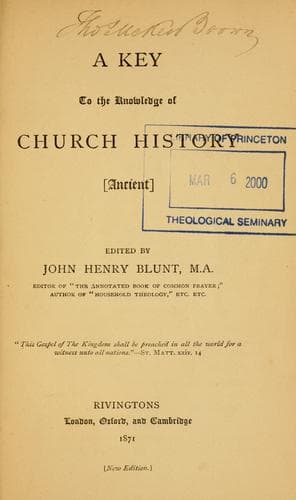
A Key to the Knowledge of Church History (Ancient)Blunt, John Henry
History
A Key to the Knowledge of Church History (Ancient)
Blunt, John Henry
Church history -- Middle Ages, 600-1500; Church history -- Primitive and early church, ca. 30-600
[2] From Dr. Steere's "Account of the Persecutions of the Early Church
under the Roman Emperors."
{66}
CHAPTER VI
The Church under the Roman Empire
A.D. 312-A.D. 680
[Sidenote: Persecution arrested by conversion of Constantine.]
[Sidenote: Outward triumph of the Church.]
The conversion of the Emperor Constantine to the Faith worked a great
change in the condition of the Christian Church. Even so early as the
year 312, when the appearance to him of the luminous Cross in the sky
was followed by victory over his enemies, Constantine began to issue
edicts of toleration in favour of the Christians; and from the time of
his sole supremacy, A.D. 324, Christianity and not Paganism became the
acknowledged religion of the Roman empire.
Section 1. _The altered Outward Circumstances of the Church._
[Sidenote: Consequent change in discipline and ritual.]
Such a change in the outward circumstances of the Church could not but
produce a corresponding alteration in its discipline and mode of
worship. The Kingdom of God on earth became a great power visible to
the eyes of men, no longer hid like the leaven, but overshadowing the
earth like the mustard-tree; and the power and influence of Imperial
Rome were employed {67} in spreading the Faith instead of seeking to
exterminate it. Christians were not now forced to shun the notice of
their fellow-men; banished Priests and Bishops came back to their
flocks; heathen temples were converted into Churches, and new Churches
were built with great splendour. The vast resources of Roman wealth
and refinement were employed to render the Worship of Almighty God
costly and magnificent, and the ritual of the Church was probably more
fully developed and brought more into harmony with the prophetic vision
of St. John than circumstances had ever before allowed.
[Sidenote: The first Christian city.]
In Constantinople, built by the Emperor Constantine on the ruins of
Byzantium, we have the first instance of a city which, from the time of
its foundation, was entirely Christian.
[Sidenote: Endowment of the Church.]
The Church was now no longer dependent on the alms of private
Christians; the revenues which had formerly been devoted by the state
to the maintenance of the heathen temples and their ministers, were
transferred to the support of Christian Churches and their Clergy, and
to the relief of the poor. Christian schools were also founded and
endowed by the emperors; and learning, as well as wealth, was thus
brought in contact with the Faith.
[Sidenote: Church honoured by the world.]
Public-domain text, read in full here on John Shaqi.
Reviews
Reviews
No reviews yet
Be the first to share your thoughts on this work.
Join the Discussion
Join the discussion
Sign in to leave a comment or review.
Sign InorCreate an account